
With the entry into force of the ESPR – Ecodesign for Sustainable Products Regulation, the chemical industry is now required to integrate the Digital Product Passport (DPP) into its processes. The objective is clear: to increase transparency, improve traceability, and make the entire supply chain more sustainable.
The chemical sector is one of the pillars of the European economy, providing raw materials and essential products used daily across numerous industrial and civil applications. Due to its environmental and health impact, it has long been subject to strict regulations, such as the REACH Regulation and the obligation to prepare and regularly update safety data sheets.
With the ESPR now fully operational, the regulatory framework is complete: the Digital Product Passport becomes a central tool also for product groups such as detergents, paints, lubricants, and basic chemical products.
The digital product passport in the chemical sector: what the ESPR requires today
In the current regulatory context, the digital product passport is no longer a future concept but a concrete requirement. Every chemical product—whether a can of paint, a detergent, or an industrial solvent drum—must be associated with a digital dossier containing all relevant information on its composition, use, and environmental impact.
The DPP includes, among other things:
a list of the chemical substances contained in the product, with indications of any hazardous components;
the product’s technical characteristics;
data on its environmental footprint, such as CO₂ emissions generated during production;
instructions for proper use and safe disposal.
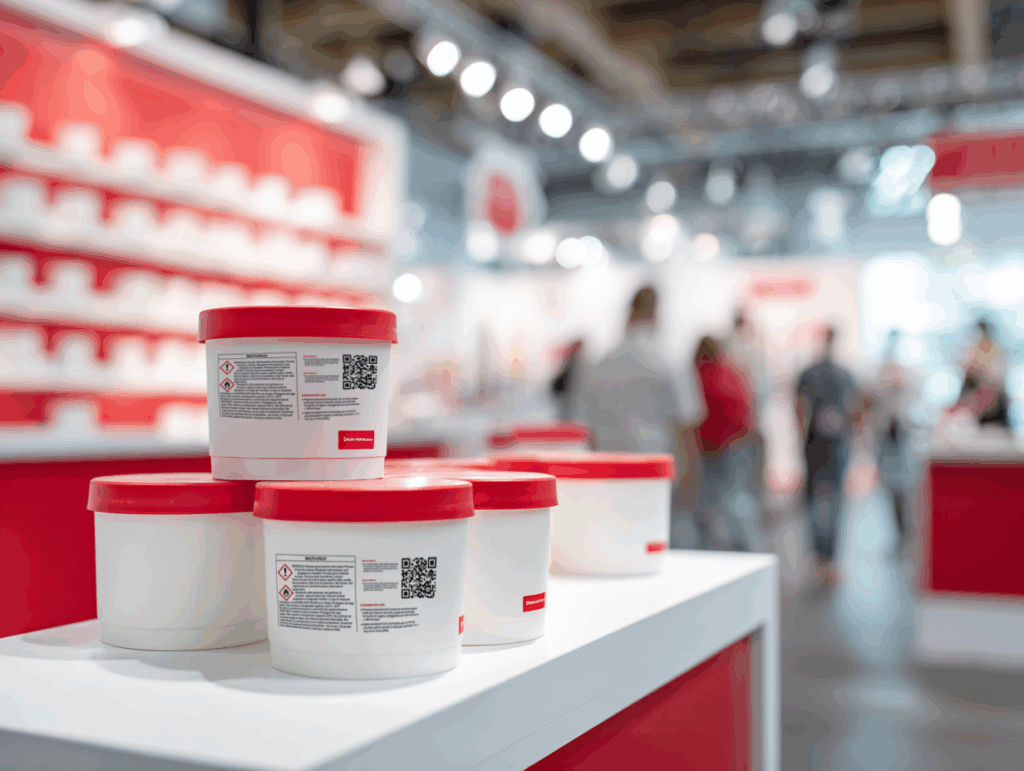
This information is accessible through a digital identifier, such as a QR code applied to the packaging. The digital passport complements and integrates traditional labels and technical data sheets, offering a higher level of detail, real-time updating, and usability for all supply chain stakeholders.
Always-available information for operators and end users
Consider a can of paint equipped with a digital product passport: by scanning the QR code, a painter can immediately access the updated safety data sheet, verify the presence and quantity of VOCs (volatile organic compounds), understand the precautions required during application, and receive clear instructions on how to manage residues and packaging in a correct and sustainable manner.
The same approach applies to industrial lubricants. The digital passport can indicate the percentage of regenerated oil used, the quality certifications obtained, and instructions for regenerating or disposing of used oil. This enables more responsible product use and more efficient chemical waste management, delivering tangible benefits for both the environment and operator safety.
Faster and more digitalized regulatory controls
With the ESPR in force, the digitalization of information also simplifies inspection and enforcement activities. Data contained in the digital product passport can be accessed at any time by the competent authorities.
For example, during import procedures, customs authorities can automatically verify the existence and authenticity of a chemical product’s digital passport. This makes it easier to identify non-compliant goods or products containing prohibited substances, contributing to a safer, more transparent European market aligned with regulatory requirements.
Operational adaptation for chemical companies
For companies operating in the chemical sector, compliance with the ESPR requires the ability to manage large volumes of technical information for each product and keep them continuously up to date.
Many companies already use systems to manage formulations and structured procedures to update safety data sheets. However, the digital product passport requires an additional step: making this data immediately accessible online, sharing part of it in standardized formats, and ensuring that every update—such as a new hazard classification or an environmental certification—is consistently propagated to all product units already placed on the market.
Certiblok as a support for the Digital Product Passport
In this already active regulatory environment, solutions like Certiblok provide practical support for chemical companies. The platform allows manufacturers to upload all relevant product documentation—formulations, certificates of analysis, safety data sheets—into a secure, decentralized cloud archive.
Each product is associated with a public QR code, which can be applied to labels or containers. By scanning the code, users can access the always-updated digital product passport. If a formulation changes or a new version of the safety data sheet is released, the company updates the document once on Certiblok, making the latest version immediately available to all users. The platform can also send automatic notifications to customers, ensuring proactive and compliant communication.
Data security and information continuity
Thanks to blockchain technology, stored information is tamper-proof and remains available over time, even in the event of changes to corporate systems. This drastically reduces the need to reprint labels or manually send technical updates: the QR code becomes the single, reliable access point to product information throughout the entire chemical product lifecycle, fully aligned with the ESPR Digital Product Passport requirements.
Towards a more transparent, digital, and sustainable chemical industry
With the ESPR already in application, Chemistry 4.0 translates into more accessible data and more controlled processes. The Digital Product Passport turns every bottle, container, or bag of chemical substances into a “talking” object, carrying all the information needed for proper use and correct disposal.
For companies adopting tools like Certiblok, regulatory compliance becomes a concrete opportunity: less paper documentation, greater customer trust, and strong alignment with European regulations, supporting a chemical industry that is increasingly sustainable, traceable, and responsible.
Book your free demo today: we will show you how to strengthen confidentiality, speed up workflows, and increase document control with a platform designed for secure collaboration.
You can contact us directly at commerciale@certiblok.com or fill out the contact form to book a time slot.
You can also explore all the benefits of the platform on the Certiblok features page or discover practical examples and case studies on our official blog.

Certiblok STORAGE
Archivia i documenti in totale sicurezza con spazi di archiviazione per ogni esigenza in un cloud decentralizzato

Certiblok SHARING
Condividi e richiedi documenti in un click. Definisci permessi e scadenze per ogni documento.

Certiblok EDITING
Modifica online i documenti con i membri del tuo Team.

Certiblok AUDITING
Il controllo completo sulla gestione dei documenti per due diligence, ispezioni o specifici utilizzi.

Compila il form qui sotto per richiedere il Piano FREE o il Piano BUSINESS completo per 30 giorni
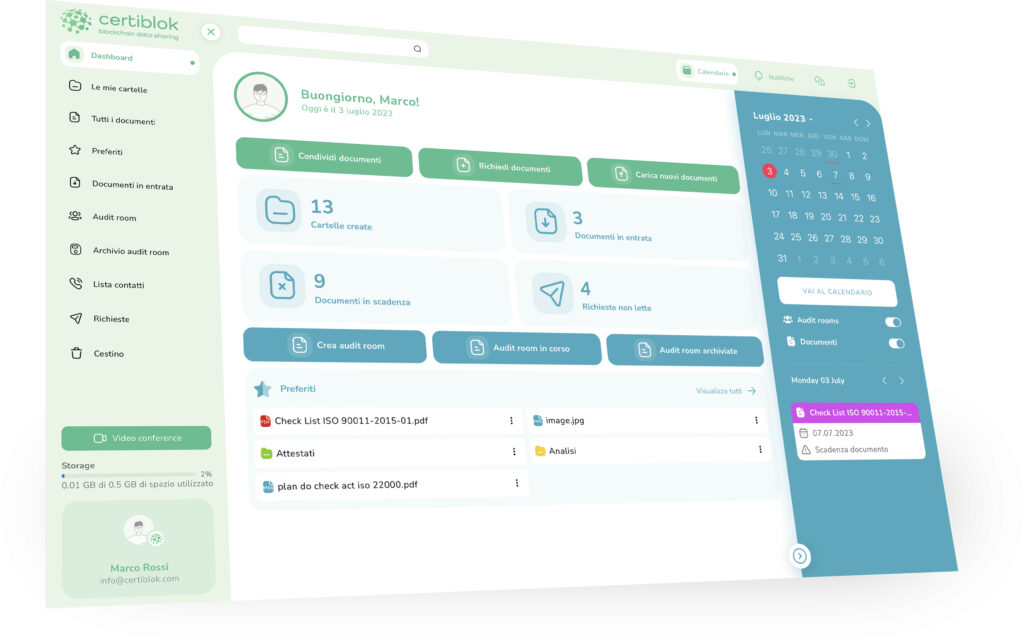
CERTIBLOK, LA PIATTAFORMA DRM® Document Relationship Management,
che rivoluziona il modo di gestire e condividere i documenti, anche quelli più riservati. Semplifica il lavoro in team, gestisce le scadenze, ti collega con clienti, fornitori, consulenti ed enti ispettivi, garantendo la massima protezione del tuo patrimonio documentale attraverso il cloud decentralizzato e la tecnologia Blockchain.Funzioni




Distributore per la Svizzera
Certificati ISO 27001
Membro di