

If you work with hazardous substances or mixtures, Chemical Safety Data Sheets — or SDS (Safety Data Sheets) — are not a bureaucratic formality: they are the core of risk communication throughout the entire supply chain.
The European regulatory framework governing them — primarily the REACH Regulation (EC No. 1907/2006) and the CLP Regulation (EC No. 1272/2008) — is uniform across all Member States, which means the same obligations apply to companies in Italy, Germany, Poland, or Spain.
Yet, operator safety depends decisively on the quality, updating, and proper distribution of these documents. In this article, we examine what the regulations require, where the most common operational risks are hidden, and how a platform like Certiblok transforms SDS management from a burdensome task into an automated process.
What the Regulations Say: REACH, CLP, and Regulation 2020/878
Chemical Safety Data Sheets are governed by Article 31 of REACH and its Annex II, which defines their structure in 16 mandatory sections: from hazard identification (Section 2) to first aid measures (Section 4), from exposure controls and PPE (Section 8) to toxicological information (Section 11).
No section can be omitted, not even those that conclude with “not classified”: their absence constitutes a non-compliance that can be detected by any regulatory authority.
The European regulatory framework was further updated with Delegated Regulation (EU) 2020/878, in force since January 1, 2023, which introduced the requirement for the UFI — Unique Formula Identifier — for mixtures, and updated the formats for communicating exposure scenarios.
⚠️ The Real Risk of a Missing UFI
A company in Lombardy continued to distribute SDS without the UFI code until the end of 2023. An inspection by the local health authority at a client’s site identified the non-compliance: the penalty — applied to the supplier, not the client — exceeded €15,000, including fines and the urgent revision of more than 80 data sheets.
Operational Challenges: Updates and Traceability
Article 31(9) of REACH is clear: the SDS must be updated without delay whenever new information on hazards becomes available, and the updated version must be sent to all recipients to whom the product has been supplied in the previous 12 months.
In practice, this creates an operational cascade of significant proportions. A manufacturer with 340 clients across 9 European countries receiving an update from ECHA must produce 9 language versions of the revised SDS and distribute them to all recipients, with proof of delivery. With a traditional email system: 3–4 working days. With Certiblok: immediate.
Then there is a fundamental aspect: traceability. Although REACH does not explicitly require a tracking system for SDS distribution, the ability to demonstrate that communication has taken place in the event of an inspection or dispute has effectively become a de facto requirement. Companies with a certified audit trail are in an incomparably stronger legal position.
How Certiblok Simplifies SDS Management
Certiblok is a platform specifically designed to address these challenges.
Its core principle is simple but revolutionary compared to traditional SDS management: the SDS is never sent as an email attachment. Instead, it is made accessible through a unique and permanent link. When the supplier updates the SDS, the link remains unchanged but points to the most recent version: all recipients automatically see the updated document, without the need for a new distribution. No outdated attachments stored on clients’ desktops, no orphan versions circulating.
In the context of an ever-evolving European regulatory framework — where each ECHA update can trigger the obligation to revise hundreds of safety data sheets in multiple languages — this architecture drastically reduces the risk of non-compliance.
Every access to the document is recorded by the platform: who viewed the SDS, when, and from which device. This generates a certified audit trail that can be consulted at any time in case of inspections or disputes. Clients also receive an automatic notification with every update, without any manual action required from the supplier.
An additional strength: recipients do not need to install any software or register. The document is accessible from any browser, on PC, tablet, or smartphone, removing technological barriers even for smaller clients.
📊 ECHA Data 2021–2023
In inspections carried out between 2021 and 2023, approximately 27% of the SDS examined showed at least one formal non-compliance with the requirements of Annex II of REACH — excluding irregularities related to format or language.
Proactive Compliance as a Competitive Advantage
In major European markets — Germany, France, and the Netherlands — inspections on SDS have intensified.
German Berufsgenossenschaften (BG) and the French Direction Générale du Travail can carry out inspections that include verifying the accuracy and version of the SDS in use.
A company using outdated SDS, even if provided by a third party, may be held jointly responsible for failing to adopt preventive measures. Proactive compliance — the ability to demonstrate at any time that all SDS in circulation are up to date, in the correct language, and made available to all required recipients — is not just about legal compliance: it is a tangible competitive advantage.
Companies certified under ISO 14001 or EMAS, and those participating in tenders with environmental requirements, find in digital SDS management a verifiable advantage.
FAQ — Frequently Asked Questions
Who is required to provide an SDS?
Any company that imports, produces, or markets substances and mixtures classified as hazardous — even in small quantities — is required to fully comply with the regulations. The obligation does not apply only to large chemical manufacturers.
How often must an SDS be updated?
An SDS must be updated without delay whenever new information on hazards becomes available, authorisations are granted or restrictions imposed, or new data on exposure scenarios emerge. The updated version must be sent to all recipients to whom the product has been supplied in the previous 12 months.
What did Regulation 2020/878 introduce?
Delegated Regulation (EU) 2020/878, applicable from January 1, 2023, introduced the requirement for the UFI (Unique Formula Identifier) for mixtures and updated the formats for communicating exposure scenarios, aligning them with the new harmonised CLP entries.
How does Certiblok ensure traceability of distribution?
Certiblok records every access to the document (user, date, device), generating a certified and consultable audit trail. Each SDS update is automatically notified to recipients, eliminating the risk of outdated versions circulating.
Book your personal call today: we will show you how to strengthen confidentiality, speed up processing times, and increase document control with a platform designed for security and collaboration. You can contact us directly at commerciale@certiblok.com or fill out the contact form to schedule a slot.
You can also discover all the platform’s benefits directly on the Certiblok features page or explore practical examples and case studies on our official blog.

Certiblok STORAGE
Archivia i documenti in totale sicurezza con spazi di archiviazione per ogni esigenza in un cloud decentralizzato

Certiblok SHARING
Condividi e richiedi documenti in un click. Definisci permessi e scadenze per ogni documento.

Certiblok EDITING
Modifica online i documenti con i membri del tuo Team.

Certiblok AUDITING
Il controllo completo sulla gestione dei documenti per due diligence, ispezioni o specifici utilizzi.

Compila il form qui sotto per richiedere il Piano FREE o il Piano BUSINESS completo per 30 giorni
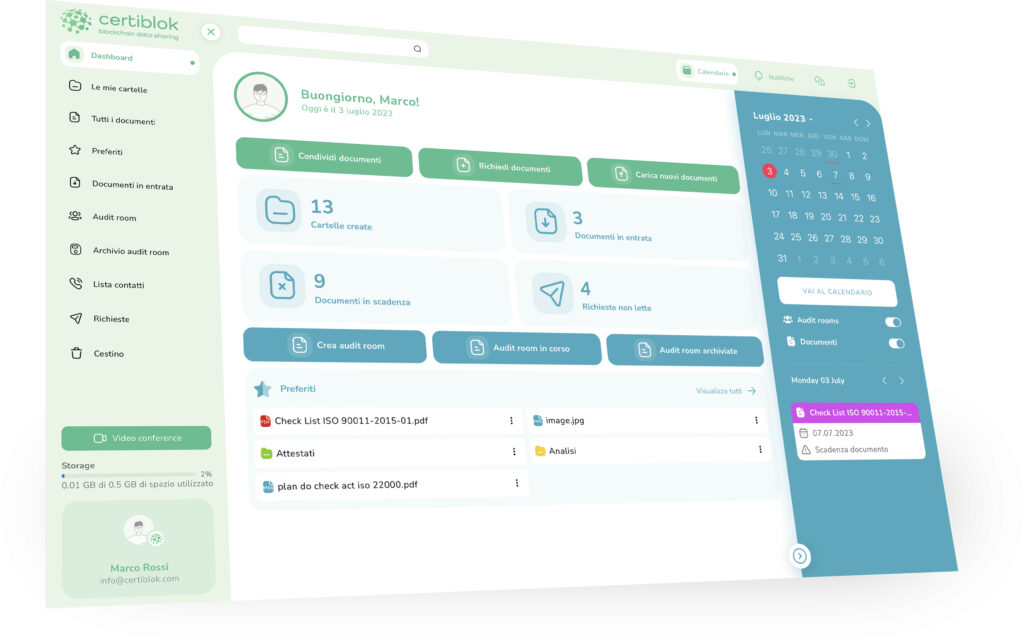
CERTIBLOK, LA PIATTAFORMA DRM® Document Relationship Management,
che rivoluziona il modo di gestire e condividere i documenti, anche quelli più riservati. Semplifica il lavoro in team, gestisce le scadenze, ti collega con clienti, fornitori, consulenti ed enti ispettivi, garantendo la massima protezione del tuo patrimonio documentale attraverso il cloud decentralizzato e la tecnologia Blockchain.Funzioni



Distributore per la Svizzera
Certificati ISO 27001
Membro di