

What is DORA and why is it crucial for your financial institution?
The Digital Operational Resilience Act (DORA), effective January 17, 2025, represents the most significant regulatory revolution for the European financial sector in the last ten years. It’s not just a new regulation to comply with, but a strategic opportunity to completely rethink your institution’s ICT architecture. The objective is twofold: to harmonize existing regulations across different Member States and to strengthen the digital resilience of the entire European financial system.
DORA applies to a wide range of entities, including banks, credit institutions, insurance companies, investment firms, asset managers, payment service providers, and crypto-asset service providers, as well as critical third-party ICT service providers. This means the impact is vast, involving over 22,000 financial entities in Europe.
Non-compliance with DORA carries administrative penalties of up to 1% of global turnover, suspension of operating licenses, and irreversible reputational damage. This makes it clear that not adapting is not an option.
The 5 pillars of DORA: A practical guide to compliance
1. ICT Risk Management
DORA requires an integrated ICT risk management framework, with clear responsibilities for the management body. You must have documented policies and procedures and continuous monitoring of threats. Often, the challenge lies in integrating heterogeneous legacy systems and training staff on new processes. Infrastructure upgrade costs can be significant, but they are a necessary investment for your security.
2. ICT Incident Management
Regulatory obligations include incident classification by severity, mandatory reporting within strict deadlines, documented recovery procedures, and systematic post-incident analysis. This implies the need for 24/7 monitoring systems, integration with alerting systems, and effective coordination with supervisory authorities.
3. Digital Operational Resilience Testing
DORA mandates regular vulnerability testing, annual penetration testing, and, for significant institutions, TLPT (Threat-Led Penetration Testing). This requires specialized resources, isolated testing environments, and advanced simulation tools. It is not a one-time activity, but a continuous process to verify the robustness of your systems.
4. Third-Party ICT Risk Management
A crucial aspect is thorough due diligence on providers, contracts with specific compliance clauses, continuous performance monitoring, and documented exit strategy plans. Traditional cloud often presents critical issues such as reliance on single providers (vendor lock-in) and limited control over data. Here, decentralized cloud can offer greater control and transparency.
5. Information Sharing
DORA promotes participation in intelligence networks, sharing of indicators of compromise, and collaboration with supervisory authorities. This creates a collective security ecosystem, where shared information helps prevent and mitigate threats.
Decentralized cloud: Certiblok®‘s answer to DORA challenges
Many institutions are addressing DORA compliance with traditional and costly solutions. However, an innovative approach is the decentralized cloud. This technology not only ensures compliance but transforms compliance costs into lasting competitive advantages.
Traditional cloud has structural limitations: a single point of failure, limited control, and often unpredictable costs. Decentralized cloud, on the other hand, offers a distributed architecture. This means no single point of failure, automatic redundancy, and inherent resilience. You have total control over your data, complete transparency over processes, and unlimited scalability.
Certiblok®, for example, uses an intelligent fragmentation model: each document is divided into 80 fragments, each encrypted with AES-256 and randomly distributed across 26,000 global nodes. This ensures military-grade security, inability to reconstruct the document without authorization, and resistance to attacks. Resilience is automatic: if a node gets compromised, another 25,999 maintain the data, with automatic network repair and a guaranteed uptime of 99.99%.
Certiblok®‘s integrated DRM® (Document Relationship Management) system ensures complete document traceability, automatic versioning, granular access controls, and an immutable audit trail. This means every activity on the document is recorded and verifiable, a fundamental requirement for DORA.
Transform an obligation into an opportunity
DORA compliance is no longer an option, but a strategic imperative. Institutions that act first will not only avoid penalties but will gain lasting competitive advantages. Adopting innovative solutions like decentralized cloud can reduce operational risks, offer a significant ROI, and eliminate vendor lock-in, providing total cost transparency.
For your IT department, implementation can happen in days, not months, thanks to native APIs for integration and automatic scalability. For end-customers, this translates into faster, more secure services, greater availability, and guaranteed data protection.
The time to act is now. Don’t wait for penalties to become a reality for your institution. Evaluate how new technologies can help you not only comply with regulations but also transform your digital strategy.
Want to explore how Certiblok® can support your DORA strategy? Contact us for a personalized consultation.
Key takeaways
- DORA is a mandatory regulation impacting over 22,000 European financial entities, with non-compliance leading to significant penalties and reputational damage.
- The regulation focuses on five key pillars: ICT risk management, incident management, digital operational resilience testing, third-party risk management, and information sharing.
- Decentralized cloud solutions like Certiblok® offer an innovative approach to DORA compliance, enhancing security, scalability, and control while transforming compliance costs into competitive advantages.
- Proactive adoption of DORA compliance through new technologies can reduce operational risks, provide a strong return on investment, and eliminate vendor lock-in for financial institutions.
FAQ
- What is the Digital Operational Resilience Act (DORA)?
DORA is a new European regulation that standardizes ICT risk management and digital operational resilience requirements for the financial sector, aiming to enhance the overall stability and security of the financial system. - Which entities are subject to DORA compliance?
DORA applies to a broad range of financial entities, including banks, investment firms, insurance companies, payment service providers, crypto-asset service providers, and critical third-party ICT providers that serve them. - What are the consequences of not complying with DORA?
Non-compliance with DORA can result in severe administrative penalties, including fines of up to 1% of global turnover, suspension of operational authorizations, and irreversible damage to an institution’s reputation. - How can decentralized cloud technology assist with DORA compliance?
Decentralized cloud offers a distributed architecture that enhances data security, resilience, and control, addressing critical DORA requirements such as incident management, third-party risk, and operational resilience testing, often more effectively than traditional cloud solutions. - When does DORA officially come into effect?
The Digital Operational Resilience Act (DORA) became effective on January 17, 2025, meaning financial entities must now be compliant with its provisions.

Certiblok STORAGE
Archivia i documenti in totale sicurezza con spazi di archiviazione per ogni esigenza in un cloud decentralizzato

Certiblok SHARING
Condividi e richiedi documenti in un click. Definisci permessi e scadenze per ogni documento.

Certiblok EDITING
Modifica online i documenti con i membri del tuo Team.

Certiblok AUDITING
Il controllo completo sulla gestione dei documenti per due diligence, ispezioni o specifici utilizzi.

Compila il form qui sotto per richiedere il Piano FREE o il Piano BUSINESS completo per 30 giorni
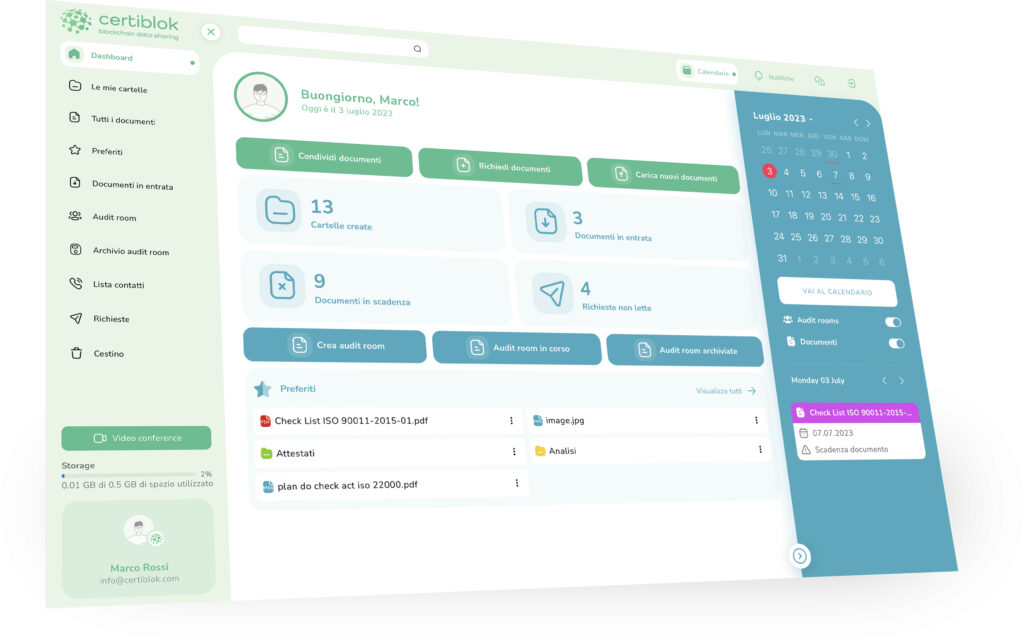
CERTIBLOK, LA PIATTAFORMA DRM® Document Relationship Management,
che rivoluziona il modo di gestire e condividere i documenti, anche quelli più riservati. Semplifica il lavoro in team, gestisce le scadenze, ti collega con clienti, fornitori, consulenti ed enti ispettivi, garantendo la massima protezione del tuo patrimonio documentale attraverso il cloud decentralizzato e la tecnologia Blockchain.Funzioni


Distributore per la Svizzera
Certificati ISO 27001
Membro di