
What Is the Digital Product Passport and Why Does It Matter to Your Company?
If you operate in the manufacturing, industrial, or distribution sector, you have probably already heard about the Digital Product Passport. But what exactly does Regulation (EU) 2024/1781 provide for, and what obligations does it introduce?
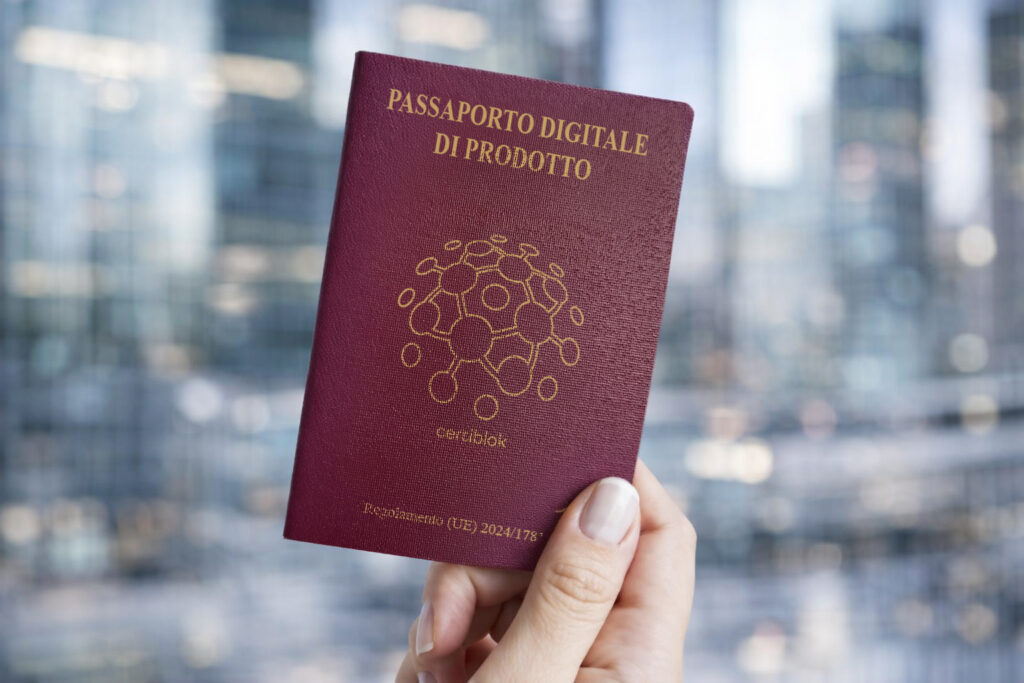
In short: starting in 2027, every product placed on the European market will have to be accompanied by a “digital passport”—a structured set of data that is digitally accessible and linked to the physical product through a unique identifier, typically a QR code. Regulation (EU) 2024/1781, also known as the ESPR regulation (Ecodesign for Sustainable Products Regulation), does not simply extend eco-design requirements: it introduces an obligation of digital transparency across the entire supply chain. This is not just about CE marking. It is about making every official product data point—materials, traceability, repairability, sustainability—verifiable in real time by anyone entitled to access it: customers, distributors, supervisory authorities, customs operators.
What Must the Digital Product Passport Contain According to Regulation (EU) 2024/1781?
The question many quality and compliance managers are asking is: what information will I actually need to provide? Regulation (EU) 2024/1781 states that every Digital Product Passport must include data on the materials and components used, origin and traceability along the supply chain, repair and maintenance instructions, the presence of hazardous substances, end-of-life disassembly information, and environmental and sustainability data.
All of this information must be accessible through a digital carrier—the QR code is the most likely tool—and must be updated, verifiable, and reliable. The critical point is precisely this: it is not enough to have the information. It must always be updated and demonstrable.
Today, in most companies, this data is scattered across ERPs, PDFs, emails, and supplier systems. When a piece of information is updated in a management system, the QR code already printed on the product continues to point to the previous version. This creates document inconsistencies that, starting in 2027, could translate into penalties, customs blocks, or sales suspensions.
The Problem Many Companies Are Underestimating
There is one question every company should ask today: can I prove in 30 seconds that the data associated with this product is official and up to date? If the answer is not an immediate “yes,” it is time to act.
The real challenge of the Digital Product Passport is not strictly technological; it is one of document governance. The data exists, but it is fragmented, static, and difficult to update in a coordinated way.
A traditional QR code points to a single PDF file: if that PDF changes, the QR code stops being reliable, or everything must be reprinted. That is why the logic of the static document is incompatible with the requirements of Regulation (EU) 2024/1781. What is needed is a dynamic digital container that keeps the same identifier while updating the content in real time, tracks every version, and guarantees data integrity over time.
How to Prepare for the Digital Product Passport Under Regulation (EU) 2024/1781
The solution is not to buy a new piece of software and start from scratch. It is to adopt an infrastructure that integrates with existing systems and structurally solves the problem of data consistency and updates.
Certiblok addresses this need through QRcube®: a permanent digital container that includes multiple files and types of content within a single QR code that is always up to date. The physical code on the product remains unchanged; the digital content evolves.
Every update generates a new tracked version, while previous versions remain archived and accessible. Data integrity is ensured through AES-256 encryption and a decentralized blockchain infrastructure, which makes the data immutable, verifiable, and protected from any alteration.
The system supports full versioning, traceability across the entire supply chain, integration with ERP and company management systems, and can operate as a third-party DPP service provider in accordance with the European regulation. In practice: printed once, updatable forever. No reprints, no changing labels, no loss of traceability.
When to Start? Before 2027
2027 may seem far away, but anyone who has already faced regulatory compliance processes knows that timelines shorten quickly. Mapping product data, structuring document workflows, integrating systems, and testing infrastructure takes months.
Companies that start today gain a concrete competitive advantage: they can present themselves to customers and supply chain partners with a system that is already compliant, transparent, and reliable. Those who wait until 2026 will find themselves racing against the deadline.
The Digital Product Passport is not just a regulatory requirement: it is an opportunity for companies that want to differentiate themselves in the European market through transparency and certified document quality.

Scan the QRcube or click this link to view a demo of a company producing aluminum profiles as an example of what you have just read in this article.
Book your personal call today: we will show you how to strengthen confidentiality, speed up processing times, and increase document control with a platform designed for security and collaboration. You can contact us directly at commerciale@certiblok.com or fill out the contact form to schedule a slot.
You can also discover all the advantages of the platform directly on the Certiblok features page or explore practical examples and case studies on our official blog.

Certiblok STORAGE
Archivia i documenti in totale sicurezza con spazi di archiviazione per ogni esigenza in un cloud decentralizzato

Certiblok SHARING
Condividi e richiedi documenti in un click. Definisci permessi e scadenze per ogni documento.

Certiblok EDITING
Modifica online i documenti con i membri del tuo Team.

Certiblok AUDITING
Il controllo completo sulla gestione dei documenti per due diligence, ispezioni o specifici utilizzi.

Compila il form qui sotto per richiedere il Piano FREE o il Piano BUSINESS completo per 30 giorni
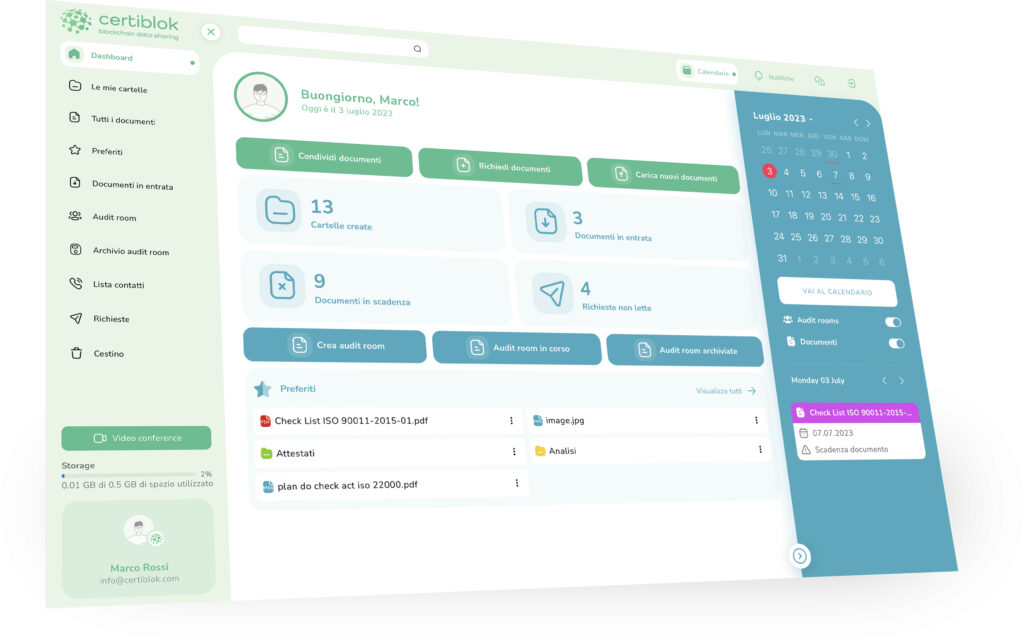
CERTIBLOK, LA PIATTAFORMA DRM® Document Relationship Management,
che rivoluziona il modo di gestire e condividere i documenti, anche quelli più riservati. Semplifica il lavoro in team, gestisce le scadenze, ti collega con clienti, fornitori, consulenti ed enti ispettivi, garantendo la massima protezione del tuo patrimonio documentale attraverso il cloud decentralizzato e la tecnologia Blockchain.Funzioni




Distributore per la Svizzera
Certificati ISO 27001
Membro di