
The Machinery Regulation 2027 — namely Regulation (EU) 2023/1230, which applies from 20 January 2027 — does not oblige you to go digital, but it changes the way a machine’s documentation must remain accessible over time. And this is precisely where a value that nobody includes in the price list is hidden: your machine may be worth less than you think, not because of a technical limitation, but because of how you deliver and maintain its documentation after the contract is signed.
In Brief
- Regulation (EU) 2023/1230 replaces Machinery Directive 2006/42/EC and applies from 20 January 2027.
- Digital documentation is an option, not an obligation: upon request, a free paper copy must still be provided within one month.
- Anyone choosing digital documentation must ensure that instructions remain accessible, downloadable, and printable for at least 10 years from the date the machine is placed on the market.
- A QR code pointing to a static link may not withstand the test of time; a Certiblok QRCube shifts the issue onto a document management system designed to last.
You have invested years perfecting your machine: revising drawings, optimizing cycles, reducing downtime, improving safety. You have built something of which you are rightly proud. Then the customer’s purchasing manager — the person who decides whether to buy from you or from your German competitor — asks you a question you were not expecting:
“If, three years from now, my maintenance technician needs the updated manual at three o’clock in the morning, where can he find it?”
You know you have done everything correctly. The documentation exists, the Declaration of Conformity is signed, the manual has been delivered. But you do not know how to answer that question. At least, not with certainty.
The Hidden Value Nobody Includes in the Price List
There is a strange paradox in Italian manufacturing. Companies invest hundreds of thousands of euros in engineering, materials, testing, and certifications. Then they deliver the machine with a PDF attached to an email — and consider the documentation chapter closed.
But the customer does not consider it closed.
The customer considers it postponed.
That machine will remain in production for ten, fifteen, twenty years. It will be maintained by technicians who were not even working for the company when it arrived. It will undergo modifications, updates, and integrations. It will be subject to inspections, audits, and regulatory changes. And every time someone looks for the correct documentation, the issue will resurface.
Those who deliver a PDF by email transfer onto the customer a burden of archiving and long-term retrievability that the customer never asked for. Those who place a QRCube on the machine transfer that burden onto a system designed to endure. The difference is not technical.
It is commercial.
What Really Changes with Machinery Regulation 2027 (and What Does NOT Change)
From 20 January 2027, Regulation (EU) 2023/1230 applies, replacing Machinery Directive 2006/42/EC. The Regulation has formally been in force since 2023, but becomes fully applicable on that date. One point requires honesty, because you will also read the opposite elsewhere: Machinery Regulation 2027 does not oblige you to switch to digital documentation.
The instructions for use and the Declaration of Conformity may be provided in digital format: it is an option, not an obligation. And several safeguards remain in place for the purchaser:
- Upon the purchaser’s request at the time of purchase, you must still provide a paper copy free of charge within one month.
- For machinery intended — even potentially — for non-professional users, essential safety information must still be provided in paper form.
So there is no obligation.
But there is a question: why is the vast majority of manufacturers choosing digital documentation even without being forced to do so? Because digital documentation, when implemented properly, is simply more convenient: less paper to manage, immediate updates, documentation that is always accessible, and one more commercial argument in front of the customer.
The key phrase is “implemented properly.” The moment you choose digital documentation, the Regulation takes it seriously and sets out precise requirements:
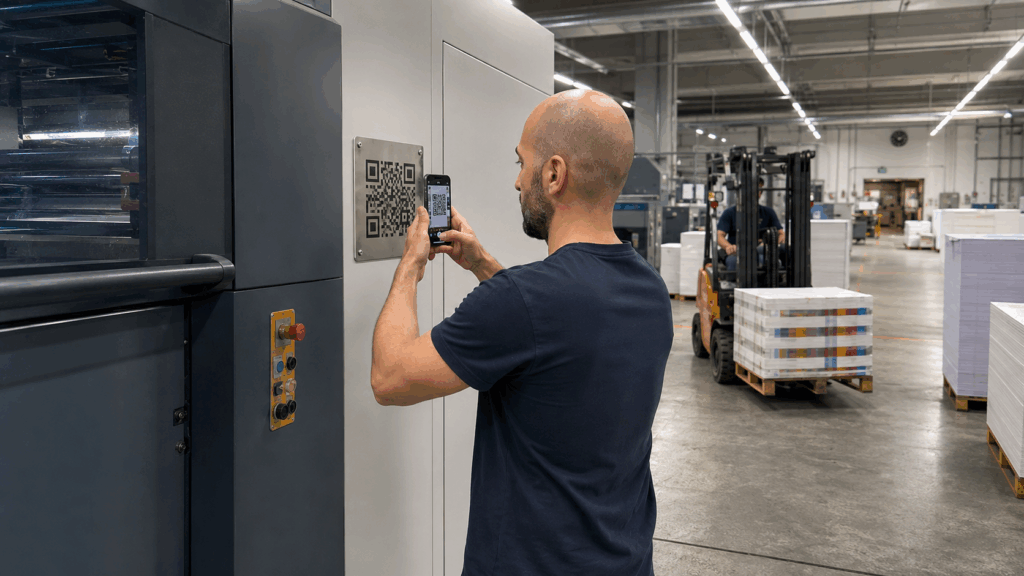
- the machine (or an accompanying document) must indicate how to access the digital instructions, typically through a QR code;
- the instructions must be viewable, downloadable, and printable;
- they must remain accessible for the machine’s expected service life and, in any event, for at least 10 years after being placed on the market;
- the information must be accurate, understandable, and available in the language of the user.
To these requirements is added an obligation that always applies: technical documentation must be retained and made available to authorities, upon reasoned request, for 10 years.
Now read that list again.
It is not a list of compliance requirements: point by point, it is a description of what the system you use to publish your documentation must be capable of doing. A QR code on the machine, guaranteed access for ten years and beyond, versions that remain accessible and printable, correct languages, proof of what was available and when.
The question, therefore, is not “Am I obliged?”
The question is:
“Will the way I deliver documentation today still meet these requirements ten years from now — when the machine has outlived the email, the shared folder, and the person who originally managed the project?”
There is another aspect to keep in mind: anyone who makes a substantial modification to a machine already on the market — an intervention that introduces new risks or worsens existing ones — legally assumes the role of manufacturer, together with the related documentation obligations. Documentation, in short, is not a chapter that closes forever at delivery.
The Trap of the “Easy QR Code”
Many manufacturers rush to solve the problem in the quickest possible way: a QR code on the machine pointing to a folder, the company website, or a link on the product page. It is understandable. It appears to solve the issue.
The QR code itself is the right approach: the Regulation specifically envisages marking the machine with a means of accessing digital information. The problem is not the QR code.
The problem is what lies behind it.
A QR code pointing to a static link has three weaknesses that only become visible when it is too late:
The Link May Stop Working
Domains change, folders are renamed, accounts expire. The machine is still in production, but the QR code no longer leads anywhere. And if the documentation is no longer accessible, the requirement for accessibility over at least ten years fails.
There Is No Version Control
When you update a document, it is not always clear which version the link points to, nor what version the customer actually saw.
It Leaves No Trace
No access logs, no evidence of who consulted what and when. In the event of a dispute, reconstructing that history becomes difficult.
A QR code pointing to a static link is not “illegal” in itself: the risk is that, over time, it may fail to satisfy the accessibility and continuity requirements that the Regulation expects from anyone choosing digital documentation.
It works until the day it truly matters.
What It Means to Have a QRCube on the Machine
QRCube by Certiblok is not a simple QR code: it is a unique and durable physical identifier designed to last as long as the machine to which it is applied. Behind it there is not a link, but a document management system.
Every document associated with the machine — manuals, Declarations of Conformity, schematics, certifications, updates — is versioned with a timestamp. None of this can be altered retroactively: the version that was online on day X remains demonstrably the version that was online on day X, even years later.
And if you need to know who accessed what and when, the private-access mode records every consultation; the public-access mode — designed so that anyone scanning the code can access the information freely, without barriers — does not track individual accesses. Supporting this robustness is a decentralized cloud infrastructure governed through blockchain technology (Ethereum): a detail that is worth mentioning only briefly, because what truly matters is the practical outcome — immutable versioning and reliable proof of which document was available, and when, without relying solely on your own word.
The QRCube is dynamic: the physical code on the machine never changes, but the document it points to can be updated. When you publish a new version of a manual, the QRCube already attached to a machine sold two years earlier — in a factory in Germany, to a customer you have not spoken with for months — already points to the updated version.
Without sending emails.
Without calling anyone.
When an inspection takes place — by you or by your customer — the system shows which document was available, in which version, on which date, and in which language.
And when the purchasing manager asks:
“If, three years from now, my maintenance technician needs the manual at three o’clock in the morning, where can he find it?”
You have a precise answer:
“Scan the code on the machine. Everything is there, always updated, in all the languages you have published. No need to call anyone.”
When Documentation Becomes a Sales Argument
There is something that sales managers who have already adopted QRCube report with a certain surprise: customers notice it before you even mention it.
They see it during commissioning. They touch it. They ask what it does. And when the customer takes out a phone, scans the code, and sees the machine’s complete documentation appear in real time, something happens that is not common in manufacturing:
The customer trusts you more.
Not because you gave a speech about compliance.
Not because you quoted Regulation (EU) 2023/1230.
But because you demonstrated, physically and before their eyes, that you care about them even after the contract is signed. That the machine they purchased will continue to be documented, updated, and defensible throughout its entire life.
That is worth more than many of the things you can write in a commercial proposal.
Who Should Act Now for Machinery Regulation 2027 (and Why Waiting Costs More Than Acting)
January 2027 seems far away until you calculate how much time is actually required. Preparing for Machinery Regulation 2027 cannot be improvised: selecting a platform, integrating it into production processes, training staff, applying QRCubes to machines in production, and managing the installed base requires months, not weeks.
Those who start now will arrive prepared.
Those who wait until autumn risk finding themselves under pressure.
There is also a push coming from the market, not only from regulation: in some sectors and Northern European markets, digital documentation compliance is already beginning to appear in procurement specifications, ahead of the Regulation’s date of application.
The best machine, if it is not documented properly, may lose tenders it should have won.
The Question Worth Asking Today
Not:
“Are we compliant with the Machinery Regulation?”
But:
“Ten years from now, if someone asks me to prove which documentation was available to the customer on day X, can I do it?”
Those who can answer yes to that question are not merely complying with a regulation.
They are building something more enduring:
A reputation as a manufacturer that customers can rely on long after delivery.

Certiblok STORAGE
Archivia i documenti in totale sicurezza con spazi di archiviazione per ogni esigenza in un cloud decentralizzato

Certiblok SHARING
Condividi e richiedi documenti in un click. Definisci permessi e scadenze per ogni documento.

Certiblok EDITING
Modifica online i documenti con i membri del tuo Team.

Certiblok AUDITING
Il controllo completo sulla gestione dei documenti per due diligence, ispezioni o specifici utilizzi.

Compila il form qui sotto per richiedere il Piano FREE o il Piano BUSINESS completo per 30 giorni
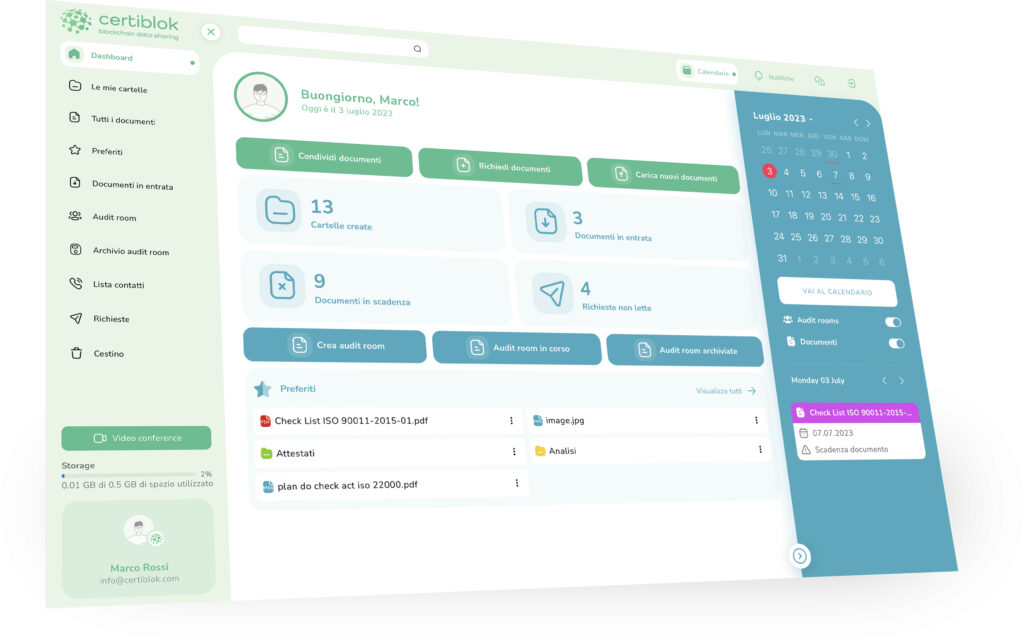
CERTIBLOK, LA PIATTAFORMA DRM® Document Relationship Management,
che rivoluziona il modo di gestire e condividere i documenti, anche quelli più riservati. Semplifica il lavoro in team, gestisce le scadenze, ti collega con clienti, fornitori, consulenti ed enti ispettivi, garantendo la massima protezione del tuo patrimonio documentale attraverso il cloud decentralizzato e la tecnologia Blockchain.Funzioni



Distributore per la Svizzera
Certificati ISO 27001
Membro di