

The Real Problem with Safety Data Sheets Isn’t Creating Them. It’s Proving They Were Delivered.
Let’s be honest: in the Chemical industry, managing REACH Safety Data Sheets has become a minefield. For years, Italian and European companies have invested in increasingly sophisticated software to produce flawless SDSs — correct CLP pictograms, translations into twenty languages, exposure scenarios, structured versioning. Everything looks perfect on paper.
But then comes the moment when those documents need to be delivered to customers. And that’s where something curious happens: companies with cutting-edge regulatory platforms still rely on Outlook, hastily attached PDFs, or a customer service employee who sends SDSs “when they remember.” The paradox is obvious.
What the REACH Regulation Actually Says (and Why Almost Nobody Fully Complies)
The REACH Regulation (EC No. 1907/2006) is crystal clear. The Safety Data Sheet must be provided to the recipient of the substance or mixture before or at the time of the first delivery. And when the SDS is updated with relevant new information, the supplier is required to send the updated version to all customers who received that product within the previous 12 months.
It sounds simple. In reality, for a chemical company handling hundreds of product references and thousands of customers, it becomes extremely complex. Because it means being able to answer — at any moment, including during an ISPRA or health authority inspection — very specific questions:
- Who purchased that product, and when?
- Which SDS version was valid on that date?
- Was the Safety Data Sheet actually sent?
- Did the customer receive it?
- When the update was released, was it notified to all customers from the previous 12 months?
- Can all of this be proven with verifiable documentation?
Today, most European organizations answer these questions using manual emails, PDF attachments, Excel spreadsheets, and internal processes that no inspector would consider truly verifiable.
An Email Is Not Proof: The Legal Risk Few Companies Measure
And this is where the real problem begins. An email does not prove delivery. It does not prove the document was opened. It does not prove which version was received, nor on what date. In the event of an incident, dispute, or inspection, this “lightweight” approach becomes a far more serious exposure than most companies realize.
In Italy, REACH-related penalties can exceed €30,000 per individual violation. And when we talk about an “individual violation,” it only takes multiplying that figure by the number of customers who were not properly notified to understand the scale of the risk.
The Hidden Cost CFOs Never See on the Balance Sheet
Chemical companies send hundreds, thousands, sometimes tens of thousands of SDSs every year. Who performs this work? Regulatory affairs teams, customer service staff, commercial back offices. Highly qualified professionals in chemical regulation spending entire days attaching PDFs, checking active customers, searching for the correct version, resending updates, and handling manual requests.
It’s an invisible operational cost. You won’t find it listed anywhere in the financial statements, but it exists — and it’s significant. Because companies are paying high-level regulatory expertise to perform data-entry tasks.
Updates Within 12 Months: The Most Critical Point of REACH Compliance
This is the aspect that most concerns professionals who truly understand the Chemical sector. When a Safety Data Sheet is updated — due to new hazard information, REACH amendments, ECHA restrictions, or new risk management measures — the supplier must resend the updated version to all customers who purchased that product within the previous 12 months.
Doing this manually, filtering by product, purchase date, and destination language across hundreds or thousands of customers, is simply unmanageable. The risk of omission is not high: it is almost inevitable. And in the event of an inspection or accident, that omission becomes the supplier’s direct responsibility.
What an Advanced SDS Management System Should Do Today
The real question is no longer: “Are our SDSs updated?”
The real question is:
“Can we prove that every customer automatically received the correct version of the Safety Data Sheet at the right moment?”
A modern SDS management and distribution system should be able to:
- integrate with the company ERP to automatically recognize orders
- identify active customers by product and purchase date
- automatically send the correct SDS in the customer’s language
- record a verifiable delivery log with timestamps
- manage regulatory revisions and send updates within the 12-month REACH window
- exclude inactive customers to avoid unnecessary deliveries
- maintain a complete audit trail accessible at any time
In practice: transforming SDS distribution from an administrative activity into a certifiable process — exactly what inspectors expect to find.
Europe’s Future: Digital, Traceable, Integrated
Europe is moving in a very clear direction: greater digitalization of chemical safety documentation, stronger interoperability across the supply chain, and more distributed yet verifiable responsibility. The Digital Product Passport (ESPR) is already mandatory for detergents under Regulation (EU) 2026/405 and will progressively extend to the entire chemicals and plastics sectors between 2028 and 2030.
Companies that have already digitized SDS management with structured traceability possess the foundational infrastructure that the DPP will require. Those that have not will need to start from scratch — with timelines and costs that are difficult to estimate today.
Safety Data Sheets are one of the most underestimated aspects of this transformation. Not because they are missing, but because the vast majority of companies cannot reliably prove who received them, when, in which version, and with which updates.
The Competitive Advantage of the Coming Years
It will no longer come from the quality of the SDS itself. That is already becoming a standard.
The competitive advantage will come from the ability to distribute SDSs intelligently, automatically, and with full traceability. From being able to answer an inspector with a single click instead of spending three days searching through email archives.
Want to discover how Certiblok SDS Manager automates Safety Data Sheet distribution with blockchain traceability and ERP integration? Book a free 20-minute demo with our team.
Book your personal call today: we’ll show you how to strengthen confidentiality, accelerate workflows, and improve document control with a platform designed for secure collaboration. You can contact us directly at commerciale@certiblok.com or complete the contact form to schedule a slot.
You can also explore all Certiblok platform features or discover practical examples and case studies on our official blog.

Certiblok STORAGE
Archivia i documenti in totale sicurezza con spazi di archiviazione per ogni esigenza in un cloud decentralizzato

Certiblok SHARING
Condividi e richiedi documenti in un click. Definisci permessi e scadenze per ogni documento.

Certiblok EDITING
Modifica online i documenti con i membri del tuo Team.

Certiblok AUDITING
Il controllo completo sulla gestione dei documenti per due diligence, ispezioni o specifici utilizzi.

Compila il form qui sotto per richiedere il Piano FREE o il Piano BUSINESS completo per 30 giorni
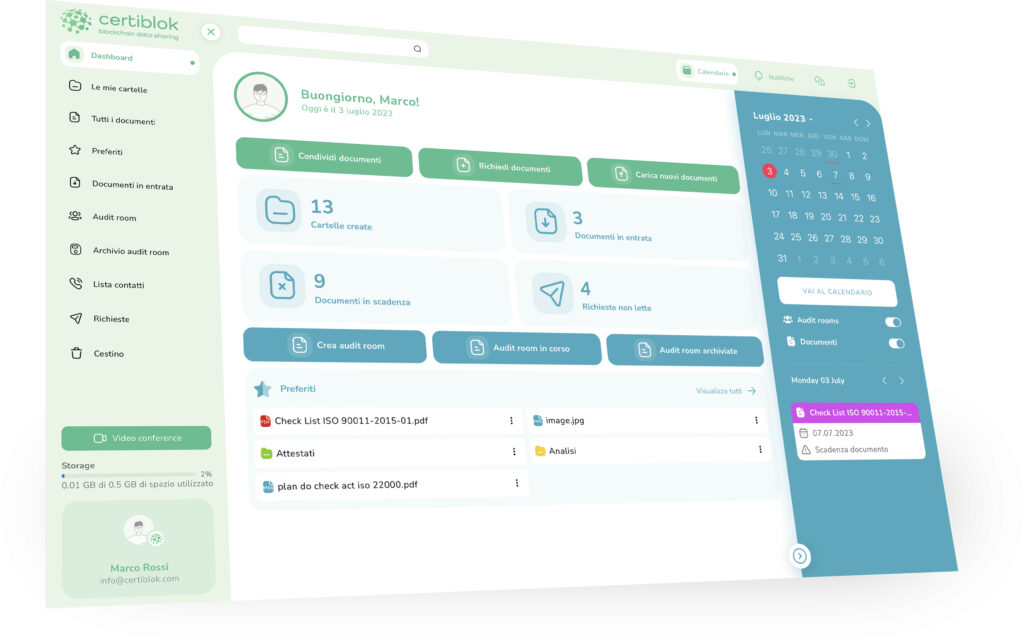
CERTIBLOK, LA PIATTAFORMA DRM® Document Relationship Management,
che rivoluziona il modo di gestire e condividere i documenti, anche quelli più riservati. Semplifica il lavoro in team, gestisce le scadenze, ti collega con clienti, fornitori, consulenti ed enti ispettivi, garantendo la massima protezione del tuo patrimonio documentale attraverso il cloud decentralizzato e la tecnologia Blockchain.Funzioni




Distributore per la Svizzera
Certificati ISO 27001
Membro di