






The true cost of a cyber attack: not just lost data
Imagine this scenario: your company suffers a cyber attack. Business documents, perhaps crucial for production or customer relations, end up encrypted by ransomware, stolen, or even worse, published online. The first thought goes to operational damage, data loss, and business interruption. But there's another threat, often underestimated, that can multiply the economic and reputational damage: the penalties imposed by regulations like NIS2 and GDPR.
We're talking about significant figures: NIS2 can expose you to fines of up to 10 million euros, while GDPR can reach up to 20 million. Added to this is an average cost of €4.5 million for the breaches studied in the EU, according to IBM (2024). This isn't just a problem for large multinationals; increasingly, SMEs and professional firms are targets of targeted attacks. The question, then, is not "if" you will be attacked, but "when" and, more importantly, "how" prepared you will be to react to limit the damage.
SMB figures in context
In a survey of SMB owners in North America, nearly 1 in 5 said a successful cyberattack would force their business to close. This is what respondents expect, not the observed closure rate (VikingCloud, 2025). Ransomware featured in 88% of the breaches involving SMBs studied by Verizon, compared with 39% for large organizations. These are shares of investigated breaches, not of all SMBs (Verizon DBIR, 2025, SMB Snapshot). The average cost of a data breach in the EU was €4.5 million (IBM, Cost of a Data Breach Report 2024); this is an average across the breaches studied, not a cost estimate for an individual SMB.
NIS2: Cyber resilience is no longer optional
What changes with NIS2
The NIS2 directive, which came into force in January 2023, extends the scope of the previous NIS to a much wider number of sectors and businesses. It no longer only concerns critical infrastructures, but also entities considered essential or important in sectors such as energy, transport, healthcare, but also manufacturing, digital, and even waste management. If your company falls into these categories, be prepared for the obligations.
NIS2 requires companies to adopt cyber risk management measures and to notify significant incidents to competent authorities within very strict deadlines. This means implementing adequate security policies, having an incident response plan, ensuring operational continuity, and securing the supply chain. Having an antivirus and a firewall is no longer enough; a structured and proactive approach is needed.
NIS2 penalties
Penalties for non-compliance with NIS2 are severe. For essential entities, they can be up to 10 million euros or 2% of global annual turnover, whichever is higher. For important entities, the penalties are up to 7 million euros or 1.4% of global annual turnover. These fines are not just a deterrent, but a way to compel companies to take cybersecurity seriously, recognizing it as a critical factor for overall economic stability.
GDPR: when personal data becomes an additional risk
Protecting personal data at the core
GDPR (General Data Protection Regulation) has been a consolidated reality since 2018. It focuses on the protection of personal data and establishes clear rules on how companies must collect, process, store, and protect it. A cyber attack that leads to the compromise of personal data (name, surname, email address, health data, etc.) represents a personal data breach, a data breach, with direct and heavy consequences under the GDPR.
When a data breach occurs, the company is obliged to notify the Personal Data Protection Authority within 72 hours of discovery, and in some cases, also the data subjects. It must also demonstrate that it has adopted appropriate technical and organizational measures to protect the data. This is where document management comes into play: how do you demonstrate that you have managed documents containing personal data securely? How do you track changes? Who had access and when? A Document Relationship Management (DRM®) system like Certiblok®, which tracks every interaction with the file and guarantees its integrity, becomes essential.
GDPR penalties
GDPR penalties are notoriously high. They can be up to 20 million euros or 4% of global annual turnover, whichever is higher. If the Italian data protection authority imposes a GDPR penalty for the same infringement, ACN does not also impose a NIS2 penalty (Italian Legislative Decree 138/2024, Art. 14(2)(c)). Other costs of the incident remain. This means that a single incident can have a devastating financial impact, in addition to reputational damage, loss of customer trust, and possible claims for compensation from data subjects.
How Certiblok® can help you mitigate risks
Addressing the challenges posed by NIS2 and GDPR requires an integrated approach to information and document security management. It's not just about compliance, but about operational resilience.
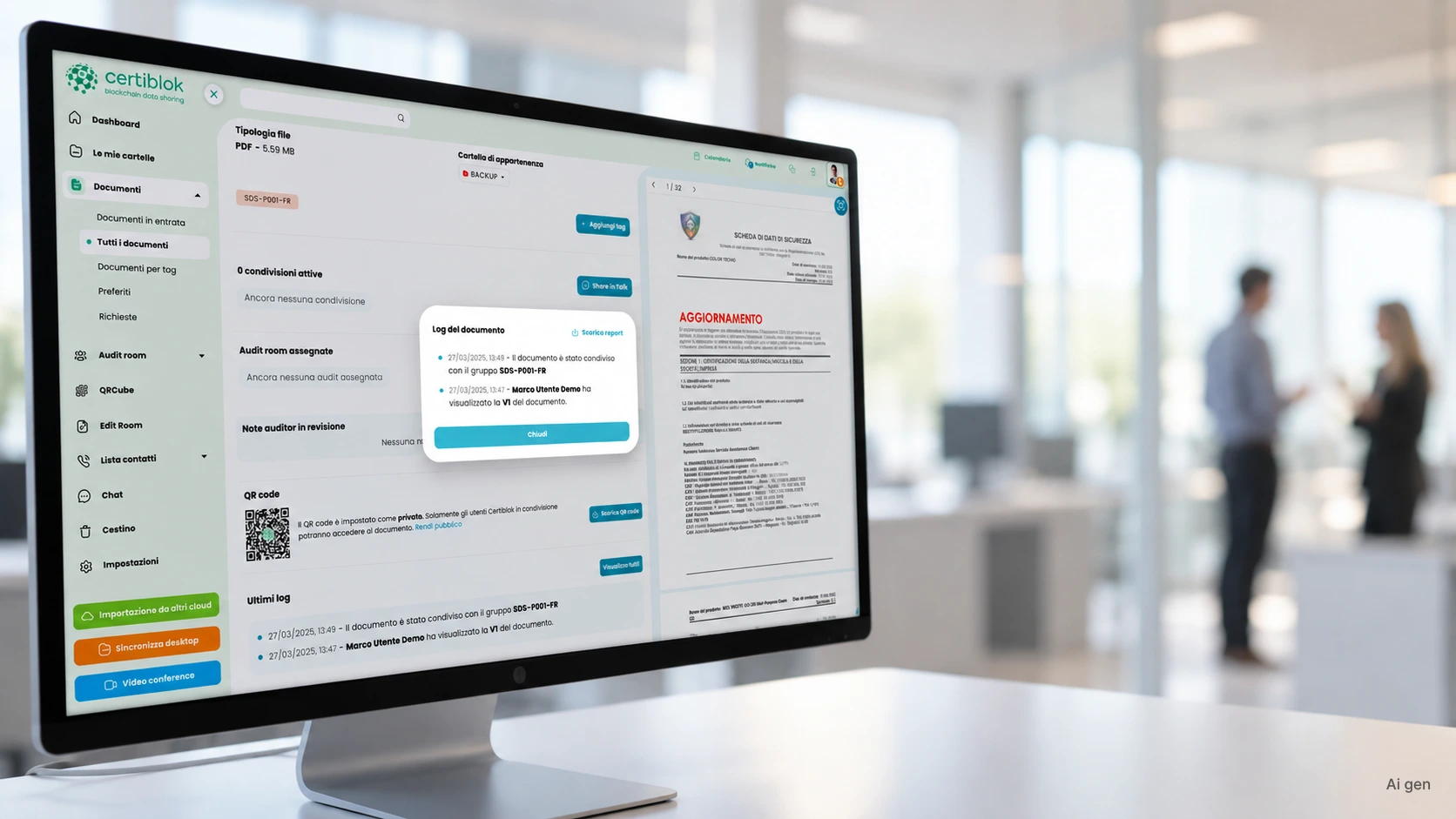
Traceability and document integrity with DRM®: Every file archived on Certiblok® has a unique and unalterable identifier. This includes the owner, all versions of the file (always accessible and unalterable), deadlines, and a complete log of activities. In the event of an audit or incident, you know exactly who did what, when, and which version was in use. Certiblok®'s DRM® technology is your first line of defense to demonstrate diligence in data management.
Secure and decentralized archiving: Certiblok® fragments your files into 80 parts, encrypts them with AES256, and distributes them across 26,000 global nodes. This decentralized architecture makes your data extremely resistant to hacker attacks, ransomware, and cryptolockers, eliminating single points of failure. Even if a node were compromised, your data would remain secure and intact. This translates into intrinsic resilience which is a key requirement of NIS2.
Secure and controlled sharing: Sharing documents, even with external users via the guest function, is done in an encrypted and controlled manner. With QRCube®, you can share files or entire folders via a single code, managing deadlines and access with passwords. If a file is updated in your Certiblok® archive, the new version automatically appears in QRCube®, ensuring that the correct, DRM®-protected versions always circulate.
Audit Room for compliance: Certiblok®'s Audit Rooms are virtual collaboration spaces ideal for consultants and inspectors. They allow for evaluation and certification without duplicating or moving files from their original location. Upon closure, a detailed report is generated. This greatly simplifies demonstrating compliance during an audit, whether related to NIS2 or GDPR.
Distributed backup: With VaultCube®, Certiblok® offers a distributed backup copy on a decentralized cloud: previous versions remain retained and restorable, supporting operational continuity even in extreme scenarios.
Don't wait for an incident, act now
The convergence of NIS2 and GDPR makes information and document security management an absolute priority. It's no longer just about protecting your data, but about protecting your company from exorbitant penalties and irreversible reputational damage.
Compliance is not a cost, but an investment in the resilience and credibility of your business. It allows you to transform a regulatory obligation into a competitive advantage, demonstrating your seriousness and reliability to your customers and partners.
Do you want to understand how Certiblok® can help you shield your company against the risks of NIS2 and GDPR? We invite you to speak with one of our experts.
Speak with a Certiblok® expert