




Regulation (EU) 2023/1230 · Compliance guide
Machinery Regulation (EU) 2023/1230: what changes from 20 January 2027 and how to prepare
The complete guide to getting documentation, digital instructions and the technical file ready for the new European rules.
Updated on 22 September 2026
The change in brief
In summary
Regulation (EU) 2023/1230 replaces Machinery Directive 2006/42/EC and applies from 20 January 2027 in every Member State, with no national transposition. Four changes weigh most on documentation: instructions for use may be supplied in digital format, the EU declaration of conformity can be reached through a web address or machine-readable code, access to the instructions must be guaranteed for the expected lifetime of the machine and in any case for at least ten years, and new requirements protect against digital tampering. Anyone who builds, imports or distributes machinery in Europe has less than two years to reorganise technical files, manuals and declarations.
What Machinery Regulation (EU) 2023/1230 is
Regulation (EU) 2023/1230 of the European Parliament and of the Council of 14 June 2023 is the new European law on machinery safety. It was published in the Official Journal of the European Union L 165 of 29 June 2023 and entered into force on 19 July 2023, but its provisions become mandatory from 20 January 2027 (Article 54). From that date Directive 2006/42/EC is repealed (Article 52).
The difference between a directive and a regulation is not a formality. A directive must be transposed by each Member State through national law, and over time the national versions drift apart. A regulation applies directly: the same text is valid in Italy, Germany, France and every other country in the Union. For a manufacturer that exports, this means one single set of rules and one correct way to document conformity.
The scope remains that of the directive, with some extensions: machinery, partly completed machinery, interchangeable equipment, safety components, lifting accessories, chains, ropes, webbing and removable mechanical transmission devices. Products with digital components and software performing safety functions are explicitly included.
The dates to mark
The calendar is short and offers no generous transition periods. Some parts already apply: the rules on notified bodies since 20 January 2024, and Member States must lay down and notify their penalty regime by 20 October 2026.
20 January 2027 is the date of application: from that day every machine placed on the market must comply with the Regulation. There is no coexistence window in which a manufacturer can choose between directive and regulation. Machines already placed on the market before that date under Directive 2006/42/EC may continue to be made available (Article 53), but every new placing on the market, including substantially modified machines, falls under the new regime.
For series production the real date is closer: machines being built today that will be sold after 20 January 2027 already need a technical file, instructions and a declaration in the new format. Documentation work should therefore be finished by autumn 2026.
The new obligations
What changes for documentation
The Regulation mainly affects how conformity is documented, retained and delivered. These are the points that change the daily work of the technical department.
Instructions for use in digital format
For the first time, instructions for use may be supplied in digital format instead of on paper (Article 10(7)). They must still be in a language easily understood by users in the Member State of destination. The manufacturer has to state on the machine, on its packaging or in an accompanying document how to access the digital instructions, must make them downloadable and printable, and must keep them available online for the expected lifetime of the machine and in any case for at least ten years after it is placed on the market.
Two duties towards the user remain. If the customer asks for paper instructions at the time of purchase, the manufacturer must supply them free of charge within one month. For machines intended for non-professional users, or that may reasonably be used by non-professionals, the essential safety information must still be delivered on paper.
In practice the manufacturer must be able to prove, for every machine and every version of the manual, that the instructions were accessible, in which version, and from when. A PDF uploaded to a corporate website that is rebuilt every three years is not a ten-year guarantee.
EU declaration of conformity reachable online
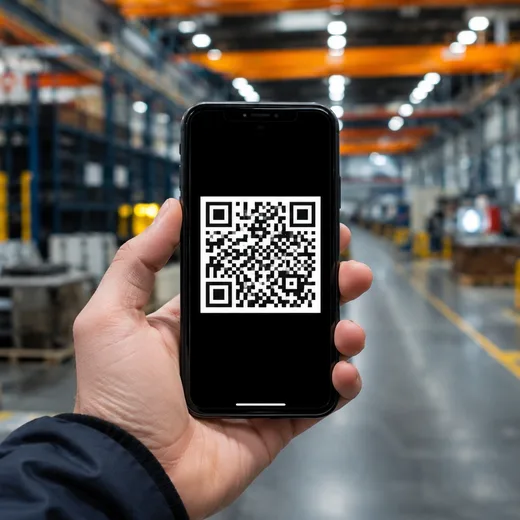
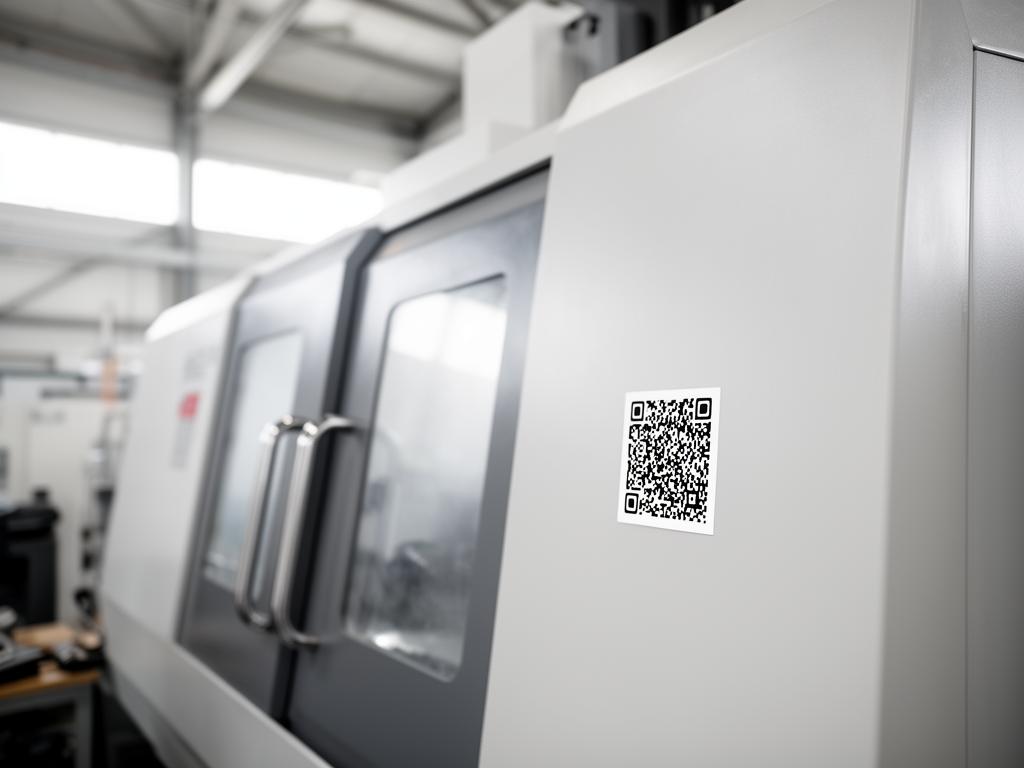
The EU declaration of conformity no longer has to physically accompany every machine (Article 10(8)). The manufacturer may indicate in the instructions an internet address or a machine-readable code, such as a QR code, where the declaration can be consulted. The availability rule applies here too: the link must keep working for the entire life of the machine.
Technical file: ten years, always available
The technical documentation and the EU declaration of conformity must be kept for at least ten years after the machine is placed on the market (Article 10(3)) and made available to market surveillance authorities on request. The file, defined in Annex IV, includes the general description, drawings, calculations, test results, the risk assessment, the list of essential requirements applied, the harmonised standards used and the instructions. For machines with software and control systems the file must also document the safety logic and, where the behaviour of the machine may evolve, how that happens.
Ten years is longer than the average life of a management system, of a server and often of a supplier. The question is not "where do I save the file" but "where will this file be in eight years, in which version, and who will still be able to open it".
Protection against corruption and tampering
The Regulation adds protection against corruption to the essential safety requirements (Annex III, point 1.1.9): the machine must be designed so that a connection to another device, or unauthorised access to the software, does not create hazardous situations, and safety-related hardware and software components must be protected against accidental or intentional alteration. Where relevant to safety, the machine must record evidence of legitimate and illegitimate interventions on those components, and safety software must be traceable through its versions and updates (point 1.2.1). This too is documentation: logs, firmware versions, update records.
High-risk machinery and third-party assessment
Annex I, Part A lists the categories of machinery whose conformity must be verified by a notified body, with no self-certification possible. Six categories are covered: removable mechanical transmission devices and their guards, vehicle servicing lifts, portable cartridge-operated fixing tools, and the two new categories, safety components with fully or partially self-evolving behaviour using machine learning that perform safety functions, and machinery embedding such a system. For these categories the technical file is examined directly and must be well ordered, complete and traceable.
Duties for manufacturers, importers and distributors
The Regulation spreads responsibility across the whole chain.
The manufacturer (Article 10) is responsible for the risk assessment, the technical file, the instructions, the declaration of conformity and the CE marking. It must keep the file and declaration for ten years and have procedures for series production that guarantee continued conformity.
The importer (Article 13) must verify that the non-EU manufacturer has carried out the conformity assessment, that the technical documentation exists, that the instructions are in the language of the destination country and that the machine bears the CE marking. It must state its name and contact details on the machine or in the documentation, keep a copy of the declaration for ten years and ensure the technical file can be supplied to the authorities on request. If the manufacturer cannot be reached, documentary responsibility falls on the importer.
The distributor (Article 14) must check marking, instructions and declaration before making the machine available, and must cooperate with the authorities by providing the documentation it holds.
Anyone who substantially modifies a machine already placed on the market, through a physical or digital change that introduces a new hazard or increases an existing risk, becomes the manufacturer for the purposes of the Regulation (Article 18), with all the documentary duties that follow.
Before and after
Directive 2006/42/EC and Regulation 2023/1230 compared
| Aspect | Directive 2006/42/EC | Regulation (EU) 2023/1230 |
|---|---|---|
| Legal nature | National transposition (in Italy Legislative Decree 17/2010) | Directly applicable across the EU |
| Instructions for use | Paper mandatory | Digital allowed; paper free of charge on request within one month; paper safety information for non-professional users |
| Declaration of conformity | Attached to the machine | May be made available via a web address or machine-readable code |
| Availability of instructions | Not defined over time | Expected lifetime of the machine, minimum 10 years |
| Technical file retention | 10 years | 10 years, with content extended to software and control systems |
| Cybersecurity | Not covered | Essential requirement of protection against corruption |
| Artificial intelligence | Not covered | High-risk categories with mandatory notified body |
| Substantial modification | Not defined | Defined: whoever modifies becomes the manufacturer |
| Date of application | 29 December 2009 | 20 January 2027 |
Action plan
Checklist: what to do by 2026
- 01Map the machines in production and identify which ones will be placed on the market after 20 January 2027.
- 02For each model, align the technical file with the content required by Annex IV, including documentation of software and control systems.
- 03Decide the format of the instructions (digital, paper, mixed) based on the risk assessment and the type of user.
- 04Define where the digital instructions live and how ten-year access is guaranteed: a stable URL, retained versions, evidence of availability over time.
- 05Prepare the access method (QR code or web address) to be shown on the machine and in the documentation.
- 06Make the EU declaration of conformity reachable through the same channel.
- 07Set up the procedure for supplying a paper copy on request within one month.
- 08Create a version register for manuals, declarations and firmware, with the date of every change.
- 09If you import from outside the EU, formalise access to the technical file with the manufacturer and keep a copy of the declaration.
- 10Check whether any machine falls under Annex I Part A and plan the involvement of a notified body.
Is your technical file ready for 2027?
In 30 minutes we bring a manual, a declaration and a technical file into Certiblok, using one of your real machines.
Request a demoFrom the rule to practice
How Certiblok supports Machinery Regulation compliance
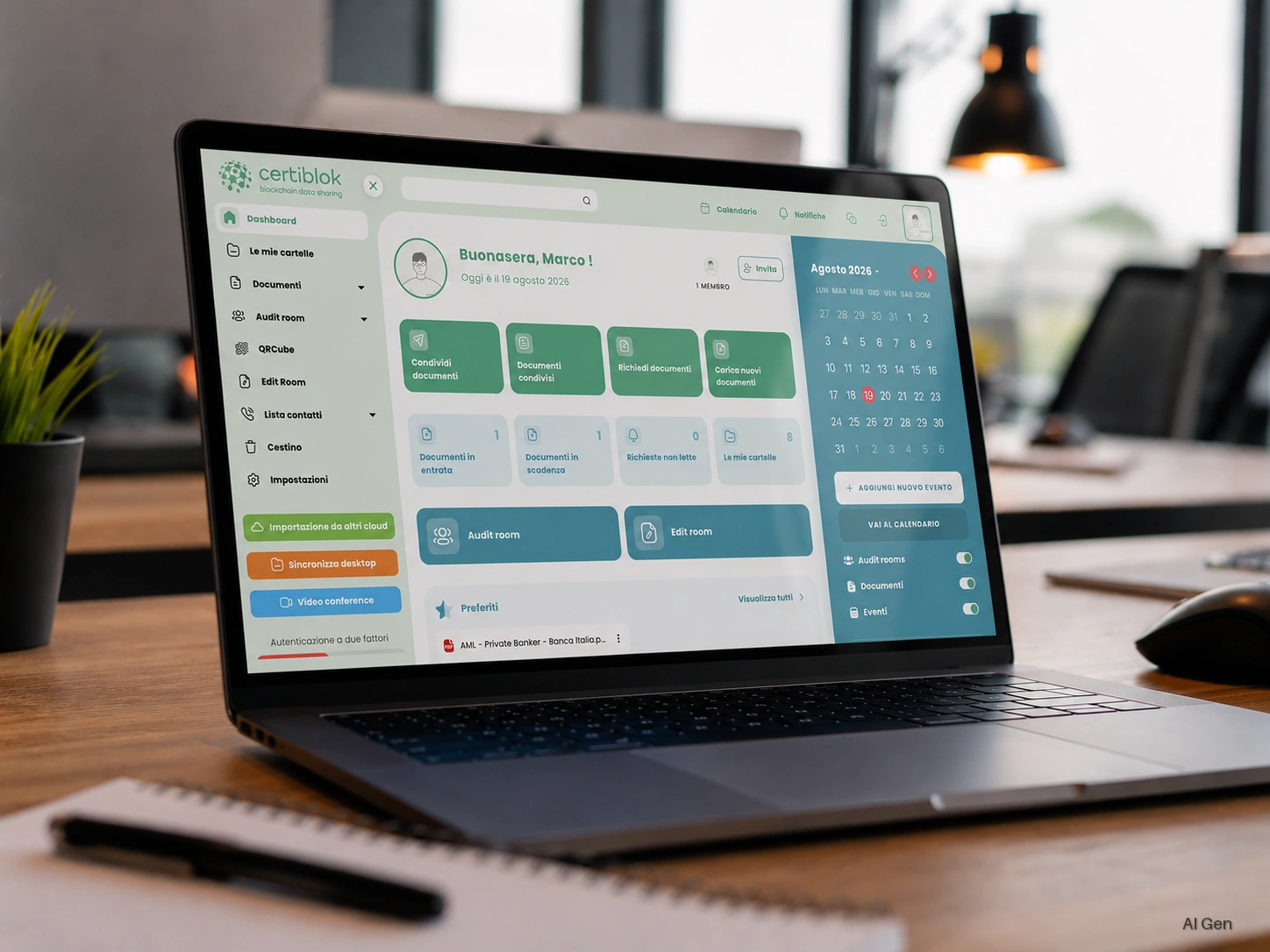
Certiblok is the secure compliance and document management platform for companies and professional firms, by Certiblok S.r.l., which operates a UNI CEI EN ISO/IEC 27001:2024 certified management system. For machine builders and importers it covers exactly the points where the Regulation demands availability over time, retained versions and controlled access.
QRcube®
A QR code applied to the machine opens the document file for that model or serial number: instructions for use, EU declaration of conformity, drawings, certificates. The content behind the QR code can be updated without reprinting the label, and every version is retained. It is exactly the access method to digital instructions and declaration that the Regulation requires.
Discover QRcube®DRM® archive on a decentralised network
The technical file, manuals and declarations are fragmented and encrypted across a network of more than 26,000 nodes: no complete copy on a single server, no single point of failure. A file kept for ten years stays available even when suppliers, servers and management systems change.
Discover DRM®Versioning with full history
Manuals, declarations and technical file documents keep every revision, with version comparison. You can show which version of the manual or declaration was published and available for a machine sold on a given date.
Controlled sharing
Instructions and declarations can be shared with customers, distributors and authorities with expiry and confirmation that the recipient opened and read them, without sending e-mail attachments.
Discover sharingAudit Room
If a surveillance authority inspects you or a notified body audits you, the documentation for a model is already collected and ordered in one place, with a log of who consulted what and when.
Discover Audit RoomsVaultCube®
Distributed, encrypted and ransomware-resistant backup of the technical file, supporting the ten-year retention requirement.
Discover VaultCube®Frequently asked questions about the Machinery Regulation
When does Machinery Regulation 2023/1230 come into effect?
Does the Machinery Regulation allow the manual to be supplied only in digital format?
Must the EU declaration of conformity still accompany the machine?
How long must the technical file be kept?
What changes for importers?
Do machines sold before 2027 have to be upgraded?
Is a QR code on the machine enough to be compliant?
Get your documentation ready before 20 January 2027
Digital instructions always reachable, declarations via QR code and a technical file kept for ten years, with every version.