






Introduction to REACH Article 31 and Safety Data Sheets
The REACH Regulation (Registration, Evaluation, Authorisation and Restriction of Chemicals) is the cornerstone of European chemical legislation. Among its provisions, Article 31 is fundamental because it defines the rules for the transmission of Safety Data Sheets (SDS). These sheets are not mere documents: they are the core of hazard communication and safety measures throughout the entire production and distribution chain. The objective is clear: to ensure that every actor, from the importer to the end-user, has the necessary information to manage the risks associated with chemical substances.
It is often thought that the SDS is a static document, to be simply filed away. In reality, it is dynamic. Information on chemical substances evolves, new toxicological data emerges, and regulations change. For this reason, Article 31 does not merely require the transmission of the SDS, but also imposes its update and repropagation. This is a critical point that many underestimate, exposing themselves to operational risks and penalties.
Who is obliged to transmit the SDS and when?
The obligation to provide an SDS does not fall on a single actor but involves the entire supply chain. Let's look at the main cases:
Supplier of a substance or mixture classified as hazardous: This is the most obvious case. Anyone placing a chemical product with certain hazardous characteristics on the market must provide the SDS to their customers.
Supplier of a persistent, bioaccumulative and toxic (PBT) or very persistent and very bioaccumulative (vPvB) substance: Even if not classified as hazardous, these substances require particular attention.
Supplier of substances included in the Candidate List for authorisation (SVHC): The list is constantly updated and includes substances with properties of concern for human health or the environment.
Supplier who receives a request from a downstream user or distributor: Sometimes, even for substances or mixtures not classified as hazardous, if a downstream user requests the SDS for specific reasons (e.g., for occupational safety), the supplier is obliged to provide it.
The SDS must be provided free of charge, in paper or electronic format, by the date of delivery of the substance or mixture. It cannot be an obstacle to the commercial transaction.
The obligation to update and repropagate: the core of Article 31
The most delicate and often overlooked aspect is the update. Article 31, paragraph 9, clearly states that the supplier must update the SDS without delay in several situations:
As soon as new information that may affect risk management measures becomes available.
Upon obtaining an authorisation or the refusal thereof.
Upon the imposition of a restriction.
Once updated, the new SDS must be transmitted free of charge and without delay to all recipients to whom the substance or mixture has been supplied in the preceding twelve months. This is the repropagation obligation. It is not enough to update one's internal archive; it is necessary to actively inform those who have received the product.
Imagine a metalworking company that uses lubricating oil. If the oil supplier receives new information on a component that requires different disposal procedures, it is their duty to update the SDS and send it to the metalworking company. The latter, in turn, must integrate the new information into its internal protocols and, if it also supplies the product , repropagate the information.
The practical challenges of repropagation
Managing this flow of updates can become complex, especially for companies that handle hundreds or thousands of SDS, such as in the chemical-pharmaceutical or food sectors. Each update requires:
Traceability: Knowing who was supplied with each specific version of the SDS in the last 12 months.
Timeliness: Sending the update without delay.
Security and integrity: Ensuring that the document arrives intact and that it is the correct version.
Historical archiving: Maintaining a history of all versions of SDS transmitted and received.
This manual process is at high risk of error. An obsolete SDS can lead to inadequate safety procedures, workplace accidents, environmental problems and, consequently, penalties.
Responsibilities of the downstream user and penalties
The downstream user is not a passive subject. They have the responsibility to verify that they receive updated SDS and to apply the indicated risk management measures. If a downstream user receives an SDS and notices that it is not compliant, or if essential information is missing, they have the right and duty to ask the supplier for clarification.
Failure to comply with the obligations under REACH Article 31 entails significant penalties, which can be administrative or criminal, depending on the severity of the infringement and national legislation. In Italy, Legislative Decree 133/2009 establishes penalties for REACH violations. In Italy, Article 10 of Legislative Decree 133/2009 provides administrative fines of €10,000–€60,000 for an SDS not provided or updated, €3,000–€18,000 for an SDS not in Italian, incomplete or inaccurate, and €15,000–€90,000 where an employer does not give workers access to the information, unless the act constitutes a criminal offence. In addition to direct penalties, there are reputational damages and costs related to any incidents.
Consider a company in the healthcare sector that uses disinfectants. An outdated SDS with new instructions on the use of specific PPE could endanger staff or, worse, patients. The consequences go beyond the fine.
How Certiblok® simplifies SDS management and compliance
Addressing the complexity of SDS management and repropagation requires appropriate tools. Certiblok® offers specific functionalities that directly address the obligations of REACH Article 31.
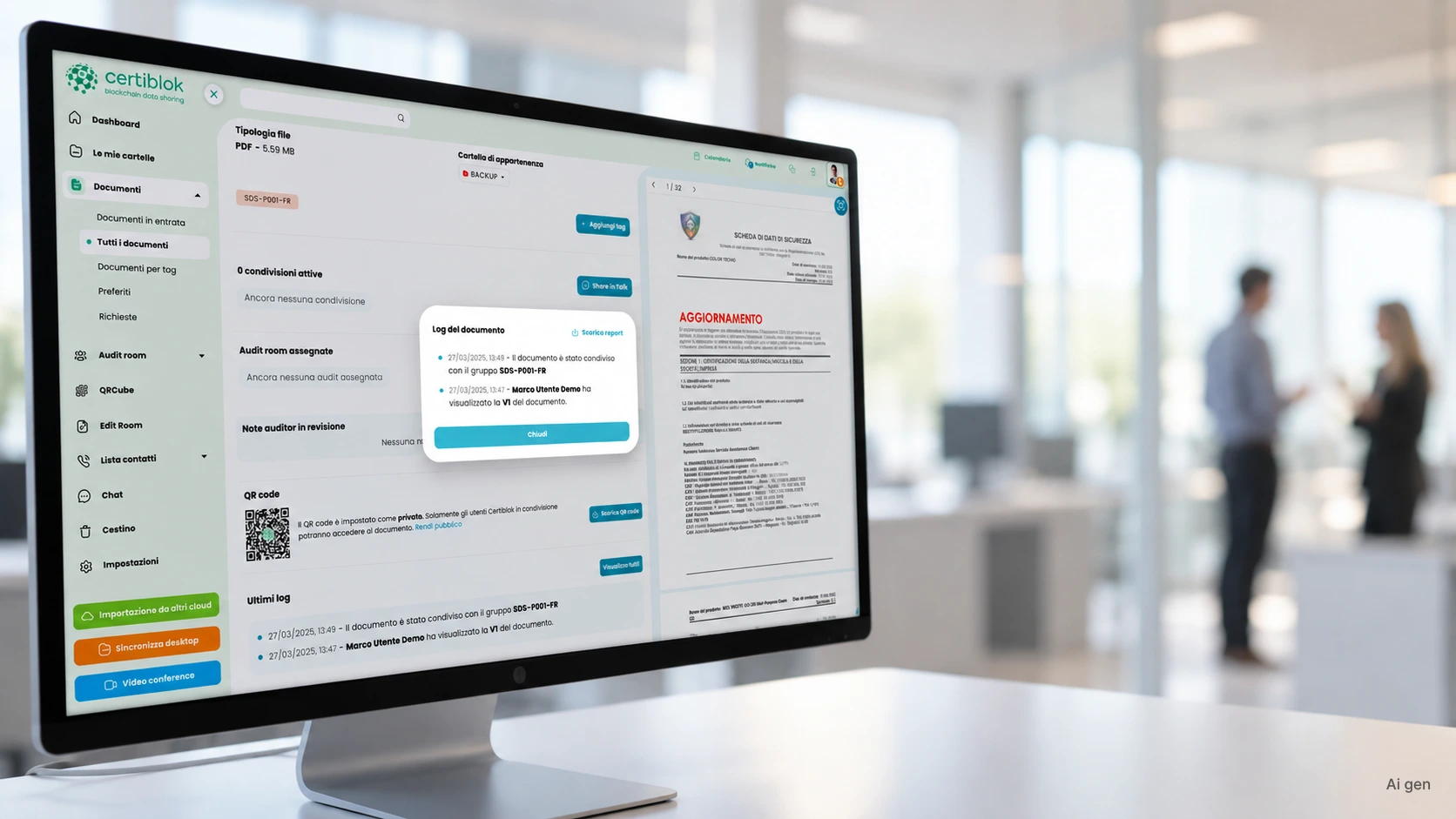
SDS Manager: automation and compliance
Certiblok®'s SDS Manager functionality is designed to automate the process. It's not just an archive, but a system that:
Centralizes SDS: All your SDS, received and generated, are in one secure place.
Manages versions: Every revision of an SDS is tracked and archived. You never lose the history.
Automatic notifications: When an SDS is updated by your supplier (if they also use Certiblok®) or by you, the system can automatically notify interested recipients.
Traceability: Every access, viewing, or sharing of an SDS is recorded, providing a complete audit trail to demonstrate compliance.
DRM® and QR Cube®: integrity and dynamic distribution
Certiblok®'s DRM® (Document Relationship Management) system ensures that every SDS has a unique and immutable "identity card". This means that whenever an SDS is updated, the new version is indissolubly linked to the previous one, tracking all changes. If a company in the manufacturing sector needs to attach an SDS to a product or machine, the QR Cube® becomes a powerful tool.
Imagine a machine in the food industry. Instead of printing and pasting a paper SDS that becomes obsolete, a QR Cube® is applied. This QR Code does not point to a single file, but to a dynamic container. If the SDS for the lubricant used in the machine is updated, you update the SDS in your Certiblok® archive, and the new version is immediately accessible via the same QR Cube® on the machine. Without reprinting, without physical intervention. This ensures that anyone scanning the QR Cube® (maintainers, inspectors, operators) always sees the latest official valid version.
The QR code helps workers consult the current version on site. It does not replace sending the SDS to customers under Article 31(8) and (9). Documentation becomes dynamic, not static, perfectly aligning with the spirit of the regulation.
An obligation to transform into an opportunity
REACH Article 31 is not just a bureaucratic burden. It is a regulation designed for the safety of people and the environment. Its correct application, including the timely repropagation of SDS, is an indicator of a company's seriousness and responsibility.
For Italian SMEs, especially those in more exposed sectors such as chemical, pharmaceutical, metalworking, or food, efficient SDS management may seem like an arduous challenge. However, with tools like Certiblok®, this obligation can be transformed into a competitive advantage. It reduces the risks of penalties, improves operational safety, and demonstrates a concrete commitment to compliance and innovation.
Don't wait for an audit or an incident to force you to review your processes. Anticipate needs and ensure that your document management is up to current and future regulatory challenges.
To find out how Certiblok® can support your company in SDS management and REACH compliance, contact us for a demonstration.
Further reading: the complete guide to the safety data sheet (SDS) and REACH.