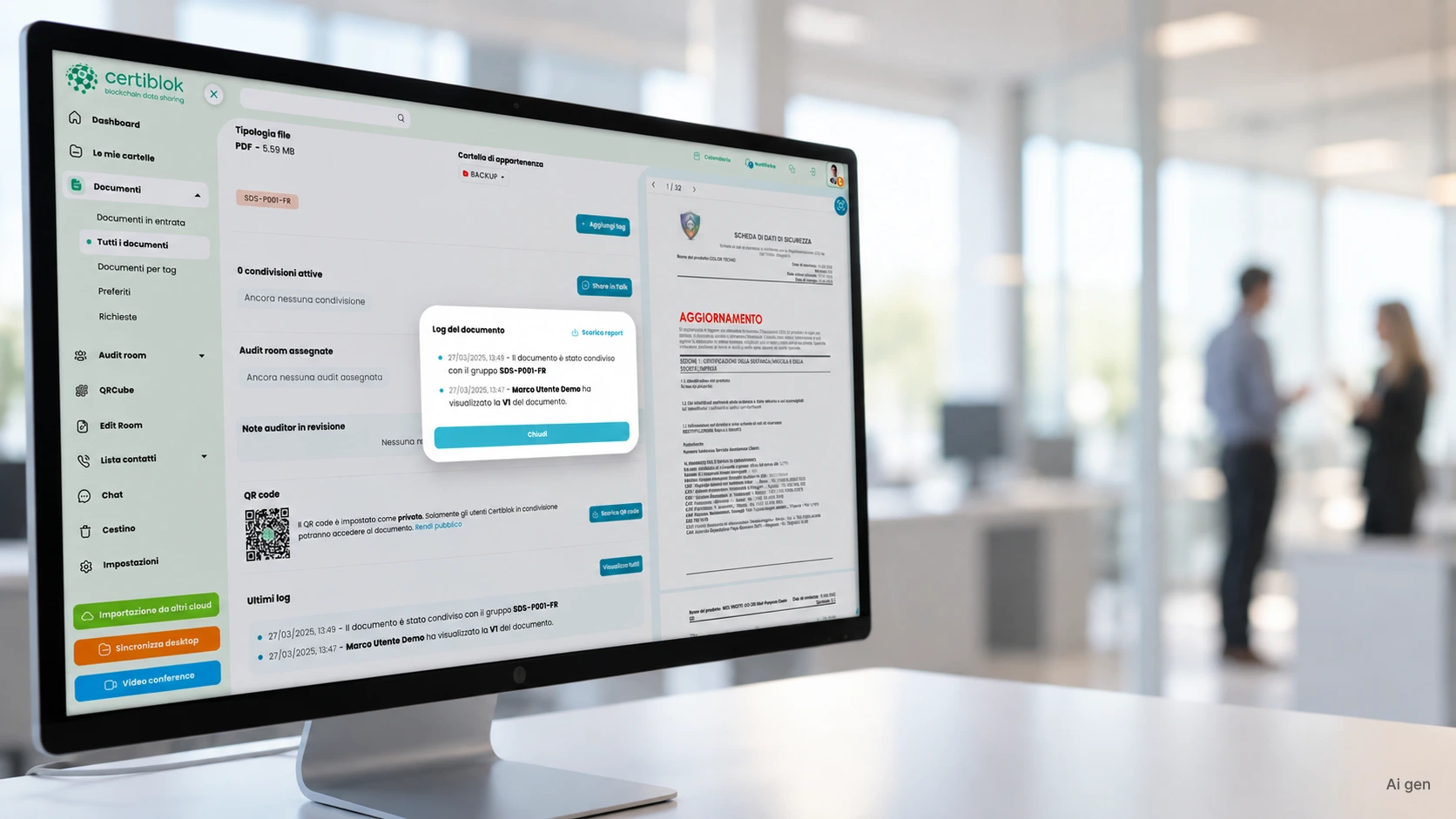
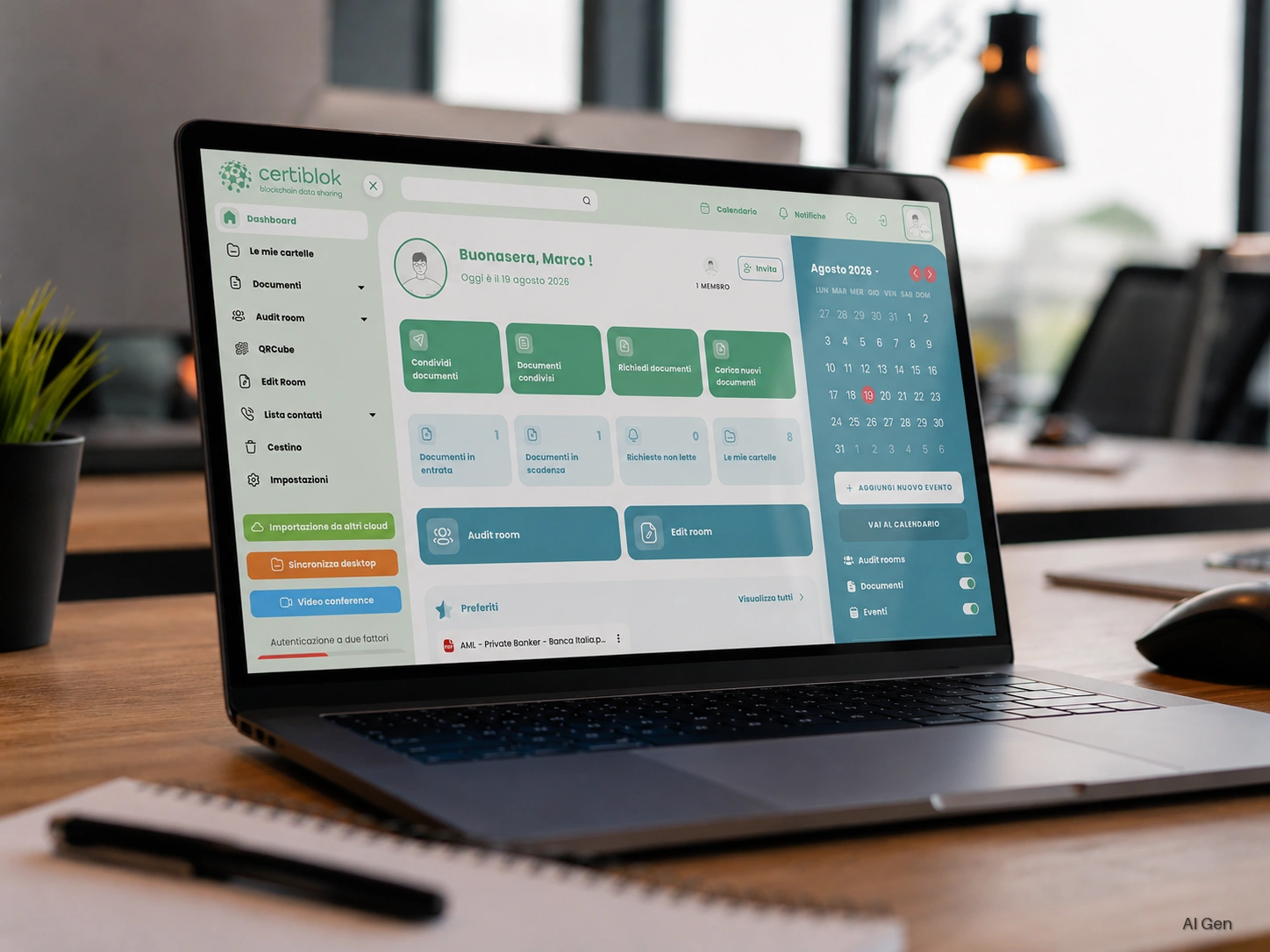





Automated document collection from external parties involves enabling an encrypted, controlled upload channel where third parties can submit files without creating accounts. This workflow eliminates the use of email and centralizes storage with granular permissions and immediate traceability.
In summary:
Manual management of email attachments exposes organizations to legal risks and corporate information fragmentation.
Passive sharing allows clients and suppliers to upload files of any size without having to register on the platform.
Every uploaded file is encrypted with the AES-256 algorithm and organized in the corporate archive with complete versioning and audit history.
Log traceability ensures compliance with the security requirements of Article 32 of the General Data Protection Regulation.
Integrating automated workflows reduces operational lead times for supplier qualification and audit preparation.
What risks are associated with collecting documents via email?
In the procurement, quality, and administrative departments of many manufacturing and service companies, the periodic collection of certificates, insurance policies, and technical certifications still takes place via email. This operational practice has clear structural limitations. When a supplier sends a Single Certificate of Contribution Regularity (DURC) or a declaration of conformity as an attachment, the file travels across unprotected intermediary servers and ends up duplicated in the individual operator's inbox.
If the attachment exceeds standard file size limits permitted by mail servers, suppliers turn to third-party temporary transfer services. These links expire within a few days, leading to broken links and the loss of the original document. In addition, there is no guarantee regarding the sender's integrity or the absence of malicious code in the delivered compressed archive.
From a regulatory standpoint, Regulation (EU) 2016/679 of the European Parliament and of the Council mandates appropriate technical measures to protect the confidentiality and integrity of processed personal data (Article 32). Receiving identity documents, contracts, or medical certificates in shared email inboxes violates fundamental principles of data minimization and access control. For companies subject to Article 26 of Legislative Decree no. 81 of 9 April 2008, failing to verify the technical and professional suitability of suppliers in a timely manner via updated documents results in severe direct penalties for the principal contractor.
How does passive sharing work in document management?
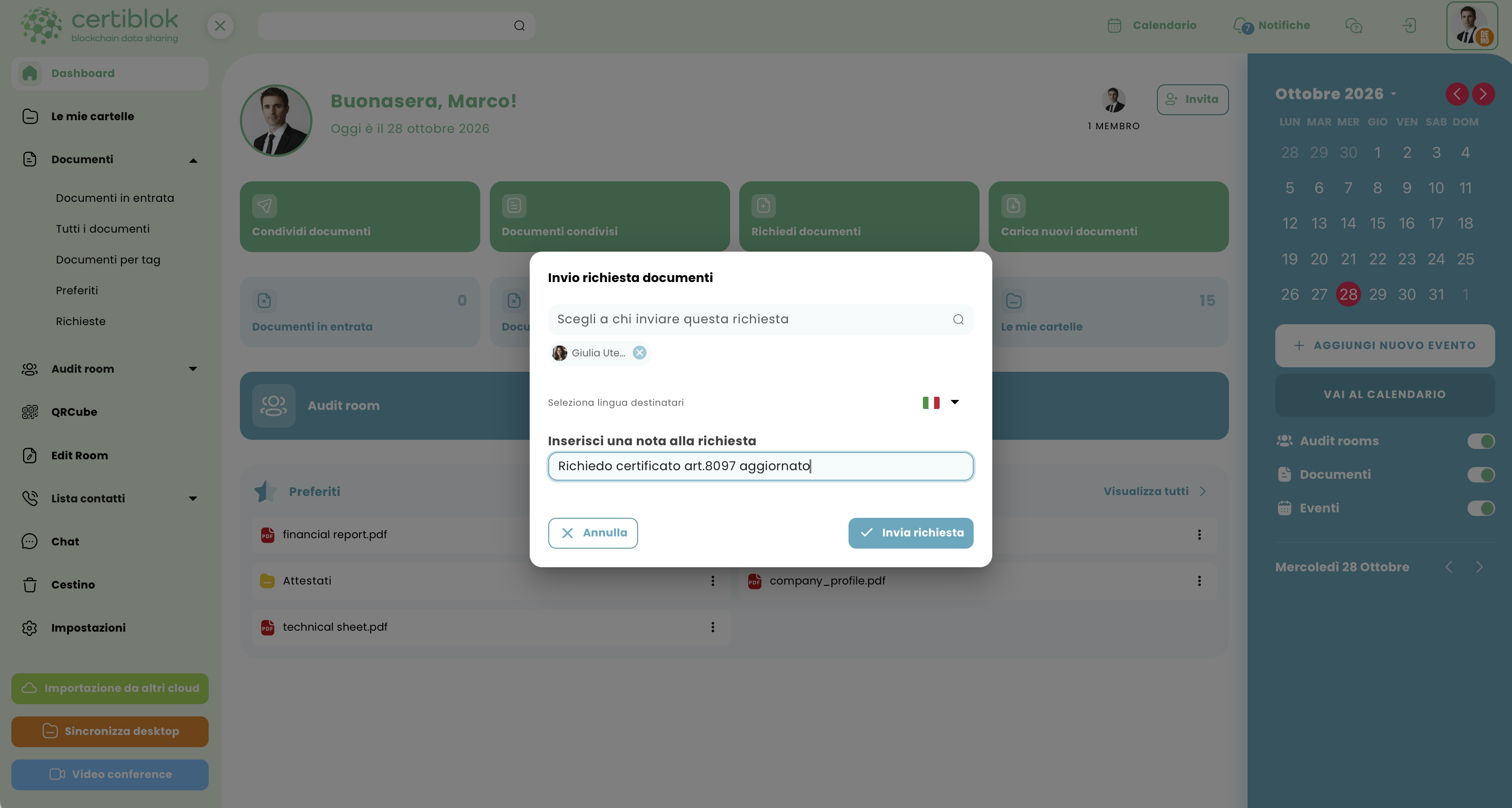
Passive sharing overturns the traditional document acquisition paradigm. Instead of passively waiting for disorganized messages, the company generates a specific document request directly from the management platform. The external recipient receives a secure link through which they can upload the requested files, without needing to purchase subscriptions or create login credentials.
Through Certiblok®'s Sharing module, the administrator selects the destination folder or the expected document type. The platform provides an encrypted entry point where the supplier or customer drags and drops their files. There are no restrictions on the overall package size, fundamentally eliminating the obstacle of limits imposed by traditional SMTP protocols.
This mechanism can be integrated into operational workflows through the use of our platform's features for secure document management and sharing. Document reception triggers real-time internal notifications for process owners, avoiding phone follow-ups and continuous email exchanges to confirm delivery.
What operational differences exist between email and passive sharing?
The following table highlights the operational gap between the conventional inbox-based method and the structured passive sharing model:
Operational parameterCollection via emailCertiblok passive sharingExternal user registrationNot requiredNo registration requiredFile size limitsGenerally blocked above 15 or 25 MBNo limit on file sizeEncryption of data at restDependent on local client, often absentEncryption with AES-256 algorithm on decentralized networkVersion assignmentManual via file renamingAutomatic via DRM® & Archive moduleChange historyScattered across different email threadsTracked and viewable in real timeFile expirationManual monitoring on spreadsheetsNotifications and alerts as expiration approaches
How to ensure the security and traceability of received files?
The security of incoming documents cannot be limited to simple antivirus scanning. When a supplier uploads a technical document, a financial statement, or a certificate to Certiblok®, the file is encrypted using the AES-256 algorithm and fragmented into 80 distinct parts. No single node stores the entire document.
These 80 fragments are distributed randomly across a global network of 26,000 storage nodes. For European organizations, the fragments reside exclusively within nodes located in the European Union, ensuring full compliance with the territorial constraints required by the GDPR. The infrastructure adopts a redundancy system based on Reed-Solomon coding: to reconstruct the entire document in its original form, any 29 out of the 80 fragments are sufficient. This architecture ensures that data remains intact and accessible even in the event of multiple failures across the network infrastructure.
In terms of logical control, the DRM® & Archive module (Document Relationship Management) assigns an unalterable identification record to each newly uploaded file. The owner, upload date, access history, and natural expiration of the document are recorded. If a supplier uploads an updated certificate relating to a previous submission, the system does not overwrite the data: it generates a new version, keeping previous versions archived and always accessible for consultation. In the event of external cyberattacks such as ransomware, should a file on the user's local computer be encrypted and uploaded to the platform, the previous version remains perfectly preserved and recoverable at any time.
How does document automation impact inspections and audits?
Document fragmentation reveals its full severity during quality, safety, or environmental compliance audits. Retrieving subcontractor compliance certificates or material technical data sheets from disparate archives requires days of low-value-added work.
Organizing document collection at the source through structured workflows turns inspections into a seamless activity. Real-world data confirms this: a structured archive enables a 40% reduction in audit time compared to paper-based or disorganized management. SOMIN Srl, a company operating in the manufacturing sector, achieved a 65% reduction in audit preparation time, passing three consecutive audits on the first round.
Within Certiblok®, collected documents can be linked directly to an Audit Room. This virtual room makes it possible to grant external inspectors and auditors selective access only to authorized files, without having to provide internal network credentials or duplicate archives. The auditor consults updated documents and, upon closing the inspection, receives a detailed read-only report.
Adopting passive sharing enables companies to transform a fragmented bureaucratic requirement into a secure, controlled business process that is immediately verifiable by third parties.
If you want to structure document collection from customers and suppliers while eliminating the risks associated with email attachments, request an informational session with our technical team via the contact page.