




The real risk in vendor audits: shared credentials
During an audit, the need to show documents to vendors is a given. Often, to simplify, the mistake is made of creating a generic account or, worse, sharing the credentials of an internal user. This is a huge weakness for corporate security.
I have seen too many companies, even structured ones, rely on approximate methods. The external consultant, the auditor, the vendor who needs to verify a specific procedure: all are given access that, even if temporary, exposes the entire infrastructure to unnecessary risks. This is not just about best practice, but a matter of cybersecurity. Every shared credential multiplies the probabilities of a data breach or unauthorized access.
When it comes to compliance, for example with NIS2, the supply chain is under close scrutiny. The risk is no longer theoretical, but regulated and subject to penalties. You cannot afford to have a weak link precisely where there should be control: third-party access to documents.
Why traditional sharing is inadequate for audits
Traditional document sharing methods present several critical issues, especially in audit contexts where precision and security are fundamental.
Email and WeTransfer: They are convenient, but offer no control once the file is sent. The recipient can copy it, forward it, keep it forever. You don't know who else sees it or whether it has been opened. Links expire, but there's no traceability.
Shared folders on public clouds: They require credentials, often with overly broad permissions. The risk is that the auditor accesses non-pertinent documents, or that credentials remain active long after the audit ends.
Physical media (USB, printouts): Expensive, slow, difficult to update, and impossible to track. And then, how do you prove that was the last valid version?
These approaches do not respect the fundamental principles of security and traceability required for modern and compliant document management. Every audit should be a controlled process, not a leap in the dark.
The obligation to control vendors: ISO 9001 and NIS2
It's not a choice, but a requirement. ISO 9001:2015 at point 8.4 mandates rigorous control over externally provided processes, products, and services. This includes the need to ensure that vendors comply with certain quality standards. To do this, you need to access their documentation or provide your own for verification.
With the NIS2 directive, the concept of security extends to the entire supply chain. It's not enough to protect your systems; you must also ensure that your vendors do not become a vehicle for cyberattacks. This means that the ways you interact and exchange information with them must also be secured. Sharing credentials is exactly the opposite of what NIS2 requires.
The solution: Audit room and granular permissions for secure sharing
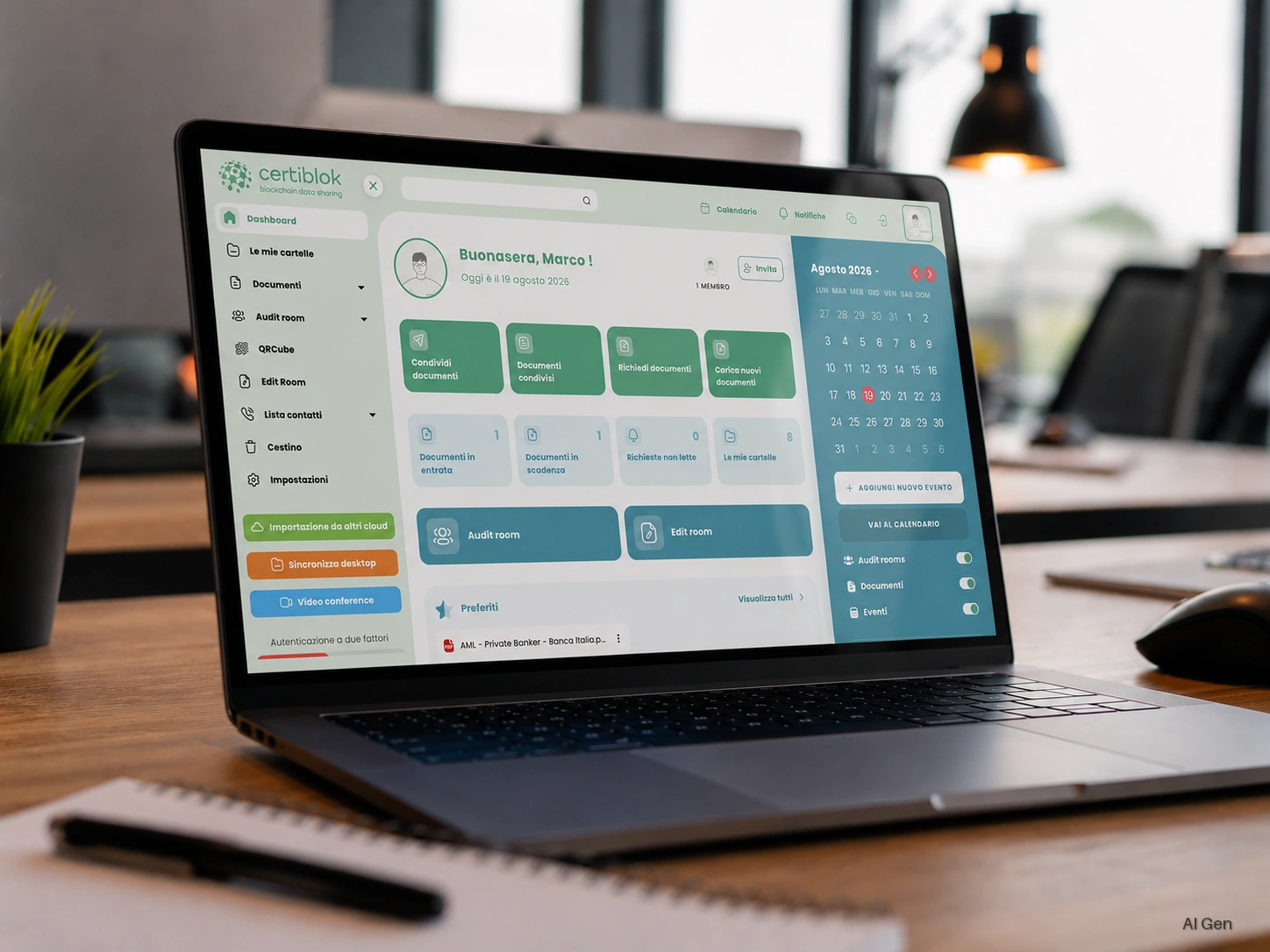
The key is to grant access only to what is needed, only for the necessary time, and to track every single action. This is where platforms like Certiblok® make a difference.
Audit room: a controlled space for inspection
With Certiblok®'s Audit Rooms, you create a virtual space dedicated to the audit. Imagine a room where the auditor can enter, consult only the documents you have selected, without ever leaving it. They have no credentials to your company, no access to your internal systems.
You decide which documents or folders to include.
You establish who can access and for how long.
You set an expiry date for the room.
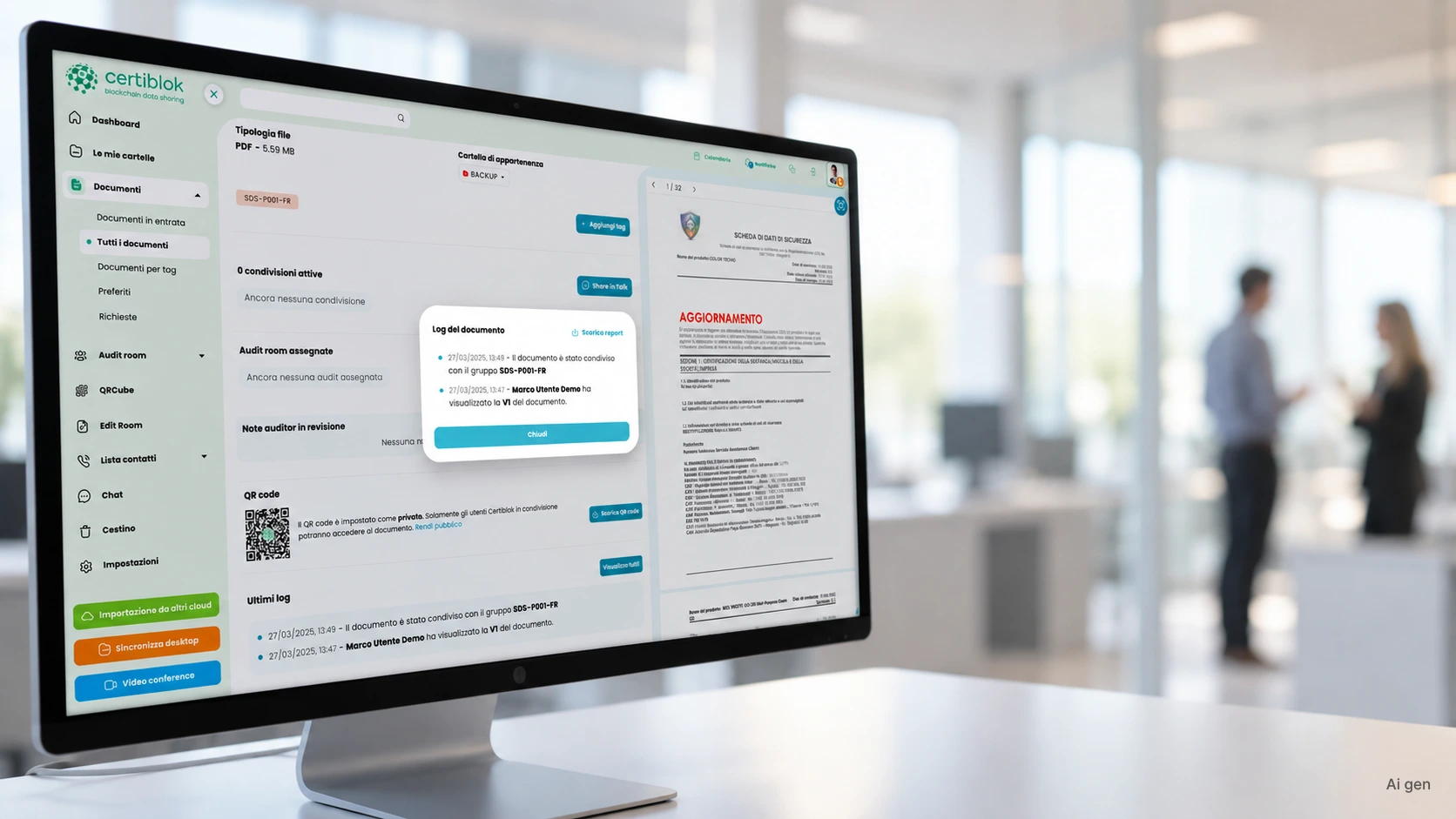
All activities are recorded in the activity LOG.
When the audit is finished, the room reaches its set expiry date and the auditor can no longer access it. Upon closure, a detailed report is generated with the consultant's or inspector's evaluation, and the history remains available for future inspections. This allows you to demonstrate compliance and control flawlessly.
Granular permissions with DRM®
Every document on Certiblok® has its own "identity card" thanks to DRM® (Document Relationship Management). This means you can set very specific permissions: read-only, ability to download, password protection for the most sensitive documents.
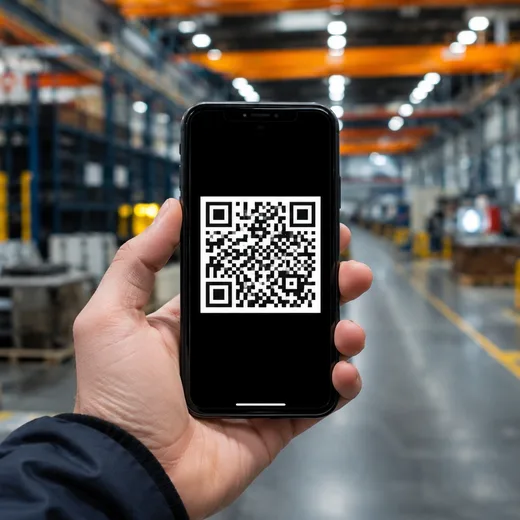
If you need to share a single manual or a certificate, you can generate a QR Cube. This is not a QR that points to a static file, but to a dynamic container. The auditor scans the QR, sees the documents you have uploaded, but never has direct access to your archive. If you update the document, whoever scans it will always see the latest official version. The previous version remains archived and tracked.
This system is ideal for sectors such as construction, pharmaceuticals, or manufacturing, where documents (technical sheets, certifications, SDS, manuals) must be constantly updated and verifiable. For example, a chemical company that needs to show Safety Data Sheets (SDS) to an auditor can do so with the certainty that only the most recent versions are consulted and that access is controlled.
Beyond the audit: benefits for collaboration and compliance
Adopting a secure sharing system like Certiblok®'s is not just for audits. It improves collaboration with vendors, partners, and clients, ensuring that everyone has access to correct and updated information, without duplication and without risks.
Think about managing the deadlines for quality certificates or licenses. With DRM®, you receive alerts and notifications, and you can easily demonstrate that every document is valid and up-to-date. The complete traceability of views and shares offers total transparency, fundamental for compliance.
Certiblok®'s decentralized cloud storage, which fragments files into 80 AES-256 encrypted parts and distributes them across 26,000 nodes, eliminates single points of failure and protects against cyberattacks, ensuring operational continuity and maximum security, an increasingly stringent requirement for SMEs.
Stop risking with shared credentials. Protect your company and simplify life for your auditors, ensuring controlled and secure access to documents. The future of document management is in controlled transparency, not indiscriminate openness.
To discover how to improve the management of your vendor audits and the security of your documents, contact us for a demo.